Gaza is a mass casualty event.

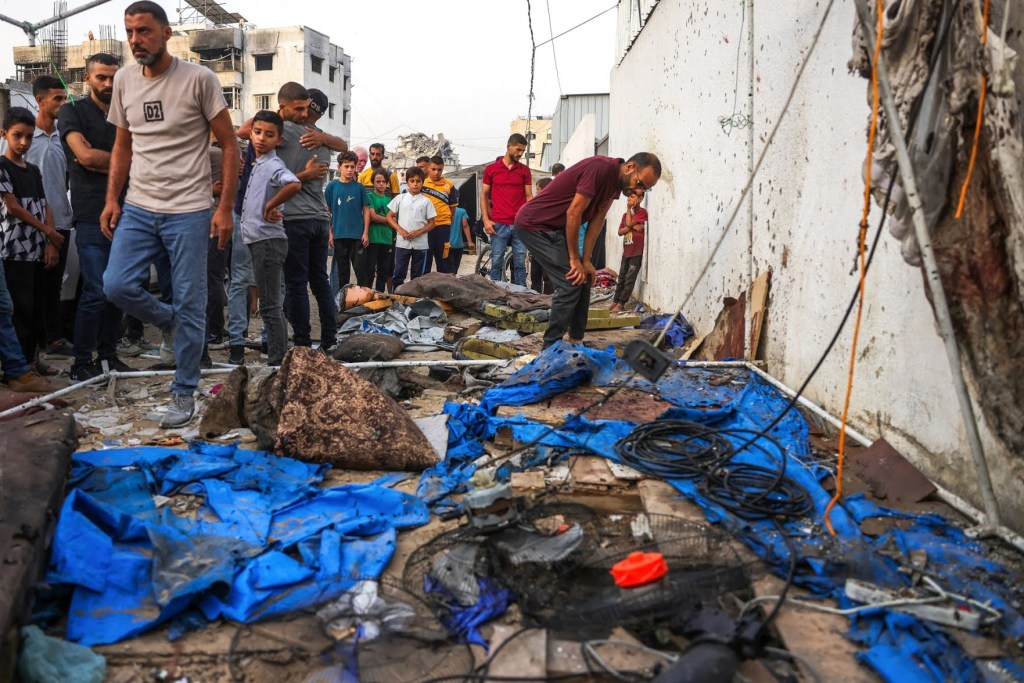
Palestinians check the destroyed Al Jazeera tent at Al-Shifa Hospital in Gaza City on Monday, following an overnight strike by the Israeli military.Bashar Taleb / AFP via Getty Images

Aug. 11, 2025, 9:03 PM EDT

By Nkozi Knight

The argument over Gaza too often collapses into labels and talking points. That framing lets us dodge the only question that matters. Are we willing to watch human beings be starved, shot at while seeking food, and buried under rubble, and do nothing?

As of August 2025, more than 61,000 Palestinians have been killed in Gaza since October 2023, according to figures collated by the U.N. from Gaza’s Health Ministry. Over 60,199 of those deaths have been fully identified by name and demographic details. Children are roughly one third of the dead. These are conservative counts and do not capture those still under collapsed buildings or the deaths from disease and hunger.    

The health system is hardly a system anymore. The World Health Organization reports that at least 94 percent of Gaza’s hospitals have been damaged or destroyed. Many operate only in fragments, without reliable power, oxygen, or surgical capacity.   

Schools have been leveled on a historic scale. U.N. satellite assessments show about 95 percent of school buildings damaged, with hundreds directly hit. The educational future of an entire generation is in jeopardy.    

Hunger is now policy by other means. The global famine monitor (IPC) warns that the food-consumption threshold for famine has already been passed in most areas of Gaza, with malnutrition and deaths rising. UNICEF has documented a sharp increase in children dying of starvation and related disease. The U.N. continues to report paltry aid flows compared with need.    

It is not just the volume of aid. It is the violence around it. After Israel dismantled the U.N.-led distribution system and backed a new contractor model this spring, multiple investigations documented civilians being shot at or killed around food sites and convoys. Hundreds have died seeking flour or canned food. These incidents are contested by Israeli authorities, but the pattern is now documented by journalists, doctors, and rights groups.   

Claims that “Hamas steals all the aid” are often made to justify these restrictions. Yet a recent U.S. government review found no evidence of massive theft of U.S.-funded aid by Hamas, even as diversion risks exist in any war. Meanwhile, Israeli far-right activists and settlers have repeatedly blocked, vandalized, or looted Gaza-bound convoys. Both truths can be held at once. Aid must be protected from diversion, and people must be allowed to eat.     

Christians are part of this story too. A Greek Orthodox church sheltering families was struck in October 2023, killing civilians. In December 2023, two Christian women were shot and killed inside the Holy Family Catholic parish compound, according to the Latin Patriarchate and the Vatican. The small Christian community has continued to suffer deaths and deprivation through 2024 and 2025.     

Here is the moral core you asked to preserve:

This is not about being anti-Semitic.

It is not about being pro-Hamas.

It is not even about taking a side on Israel’s right to be in the Middle East.

It is about being human.

It is about the countless lives lost.

The countless lives destroyed.

The generations of families wiped from the earth.

It is about the deliberate starvation of people who are already trapped in devastation.

International law is not silent about any of this. The Genocide Convention defines genocide as specific acts committed with intent to destroy a protected group. Those acts include killing, causing serious bodily or mental harm, and inflicting conditions of life calculated to bring about a group’s physical destruction. You do not need to be a lawyer to understand what “conditions of life” means when aid is throttled and families are shot at while queueing for food.   

Courts have acted, even if governments have not. In January and again in May 2024, the International Court of Justice ordered Israel to prevent genocidal acts and to ensure unimpeded humanitarian access, including ordering a halt to the offensive in Rafah. In November 2024, ICC judges issued arrest warrants for Israel’s prime minister and former defense minister on charges that include using starvation as a method of warfare. In July 2025, the ICC rejected Israel’s bid to withdraw those warrants.     

What should follow is not more argument. It is practical action.

Open the crossings wide and keep them open under neutral monitoring. Protect aid corridors and reinstate U.N.-led distribution at scale. Stop firing near food lines. Restore funding to agencies that have the reach to keep children alive. Enforce the ICJ’s orders. Respect the ICC process. None of this precludes holding Hamas accountable for the atrocities of October 7 or for any diversion of aid. It simply refuses to make civilians pay the price for crimes they did not commit.  

History records the numbers. Conscience remembers the names. Gaza is not a referendum on anyone’s identity. It is a of our own.

While You’re Watching Game 7 of the NBA Finals, We’re Being Sold Out Piece by Piece

We’re not watching a dramatic fall of America. There are no breaking news alerts about the end. No explosions in the streets. No economic sirens.

But make no mistake….something terrible is happening.

Piece by piece, decision by decision, we are being sold out. Our labor, our taxes, our future, it is all being extracted. And while it happens, we are told to look the other way while letting AI take many of our jobs.

Watch the game. Scroll the feed. Place a bet. Argue online about culture wars that do not affect your rent, your hospital bill, or your ability to afford groceries.

Meanwhile, the money keeps flowing. Out of your paycheck. Out of your neighborhood. Out of this country. Straight into the hands of foreign governments, defense contractors, and elite interests.

This is not the dramatic fall of a nation. It is a transfer of wealth, security, and stability away from ordinary Americans and toward a system that was never built to serve us. It is a system that acts globally, extracts locally, and survives only as long as we do not look directly at it.

You can call it a government. You can call it a machine. But what it really functions as is an empire. And the longer we ignore it, the more it takes.

The Cost of That Empire Is Being Paid in Evictions and Empty Refrigerators

While your tax dollars are used to fund missile systems in Israel, people across the United States are struggling just to keep a roof over their heads. Since 2020, the median price of a home has risen by more than 40 percent. Interest rates have climbed above 7 percent, making homeownership unreachable for millions (National Association of Realtors, 2024).

At the same time, Americans like myself, carry over $1.7 trillion in student loan debt. Medical bankruptcies remain the most common form of personal financial ruin. A premature baby that has to stay in a neonatal intensive care unit for over a month can cost well over a million dollars. On top of that, more than half of the country cannot afford an unexpected five hundred dollar emergency.

And yet, every year, tens of billions of dollars are approved for foreign aid without hesitation.

Israel receives more U.S. taxpayer money than any other nation on Earth. Since 1948, it has received over 300 billion dollars in aid, including nearly 4 billion annually in guaranteed military funding (Congressional Research Service, 2023).

That money has helped fund a public healthcare system, subsidized childcare, and modern infrastructure. Israel’s students have new schools. Their citizens have access to doctors without going bankrupt.

Meanwhile, in American cities, teachers work second jobs. Classrooms go without books. People drive across state lines to afford prescriptions. And in cities like Flint, Michigan and Jackson, Mississippi, families still live without safe drinking water.

This is not about scarcity. It is about priorities.

An Economy Built to Keep Us Consuming

We are told that the economy is doing well. But it only looks strong on paper because we are constantly spending to survive.

Wages have remained flat for decades, while the cost of everything else has gone up. Food, gas, housing, tuition, and insurance have all exploded. But instead of fixing the system, the solution we are offered is more debt.

Buy now, pay later.

Zero percent financing.

Monthly subscriptions for everything, even the essentials.

Our economy runs on credit cards and desperation.

We are not building wealth. We are surviving one paycheck at a time, and no one is willing to admit it.

And when that stress becomes too much, we are handed another solution, a distraction. Sometimes it’s a RICO case of a famous celebrity, other times it’s the United States bombing an empty nuclear facility in Iran, and other times it’s something as simple as sports and sports betting.

There is always something to pull our focus. Sports betting is now a multi-billion dollar industry thanks to ESPN, Draft Kings, Prize Picks, and MGM Sports betting. On television, sex-laden reality shows dominate prime time and paid subscriptions. Viral celebrity drama trends daily. Meanwhile, airstrikes in Gaza or explosions in Tehran are buried beneath all this noise but we pay for all of it.

None of this is random. It is a carefully designed system.

We Fund a Better Life for Others While We Are Told to Settle for Less

The average American is constantly being told to sacrifice.

Tighten your belt.

Use credit.

Be patient.

Inflation is temporary.

Work harder.

But there is no austerity when it comes to military aid.

There is always money for war. There is always money for foreign governments. There is always money to rebuild somewhere else in a land most have never been, but there is nothing for Maui, East Palestine, Flint, New Orleans, and many other cities in America.

Since 1948, Israel has received over 300 billion dollars in U.S. assistance (Reuters, 2024). That money has helped create one of the best publicly funded healthcare and education systems in the world—for a country with fewer people than New York City.

In America, we have veterans sleeping on the street in every major city.

We have kids learning from worksheets because their school cannot afford books.

We have families rationing insulin and choosing between medication and rent.

This is not just a funding issue. It is a values issue.

We are paying for the stability of others while our own communities are crumbling.

They Keep Us Distracted So We Do Not See It

Every time the conversation gets too close to real issues, the distractions flood in.

The headlines suddenly shift, and Operation Mockingbird goes full tilt. The scandals erupt more salacious than the prior one. The outrage machine gets turns on, and Americans are pinned against each other.

We are told to obsess over celebrities, argue over culture wars, and follow political soap operas like they are sports teams.

This is not a coincidence. It is the only way this corrupt system survives.

Because if we stop fighting each other, we might start asking the real questions.

Where is the money going?

Why can’t we afford basic services while funding foreign militaries?

Why is our economy built on debt and distraction?

And who exactly is benefiting from all of this since it’s not US?

This Is Not Incompetence. It Is a Strategy.

The truth is that the United States has all the resources it needs to take care of its people….if it wanted to.

But we do not. Not because we can’t. But because we are not supposed to.

We are expected to work, consume, and remain distracted.

We are expected to stay tired, stay anxious, and stay divided.

And we are expected to believe that any attempt to change the system is unrealistic, unpatriotic, or impossible.

But the truth is, the system is not broken. It is functioning exactly as designed.

It is designed to take.

It is designed to distract.

And it is designed to leave us wondering why we are doing everything right and still falling behind.

Can You Relate

If you are working harder than ever but getting nowhere, you are not alone.

If you are wondering why another country has healthcare and you cannot afford a routine checkup, you are asking the right question.

If you are tired of being told that sacrifice is patriotic while billionaires and foreign allies get blank checks, then maybe it is time we stop playing along.

They do not fear Iran. They do not fear China. They do not fear Russia.

What they fear is that you will start paying attention.

Because the moment we stop watching the show and start watching the system, the game is over.

Sources

National Association of Realtors. (2024). Median home price trends

Congressional Research Service. (2023). U.S. Foreign Aid to Israel

Reuters. (2024). Israel aid totals and annual packages

CNBC. (2023). 80 percent of Americans live paycheck to paycheck

Cato Institute. (2021). U.S. Military Footprint: 750 bases in 80 countries

Al Jazeera. (2021). U.S. global base presence overview

The Lingering Shadows of Imperialism: Exploitation of African Nations

As someone who has served in the military, I’ve had firsthand insight into the geopolitical dynamics that still play out across the globe. One particular issue that has always been close to my heart is the persistent exploitation of African nations by former colonial powers and the United States.

Niger, a landlocked country in West Africa, serves as a stark example. It is the source of 5% of the world’s uranium, a precious resource vital for nuclear energy and weapons. Yet, despite its immense wealth beneath the ground, Niger consistently ranks as one of the world’s poorest countries. This incongruity can be attributed to the continued imperialism and exploitative tactics employed by Western nations.

Historically, countries like France and Great Britain have left indelible marks on Africa, ostensibly ending colonization, but in truth, perpetuating a new form of neocolonialism. France, for instance, still exerts considerable economic influence on many of its former colonies, including Niger. Complex agreements and unequal trade dynamics ensure that while African nations supply raw materials, they see only a fraction of the profits.

The United States, though not a colonial power in Africa, has also been implicated in this exploitative dynamic. The establishment of military bases across the continent serves dual purposes: it’s positioned as a safeguard against extremism and other threats, but it also ensures that the U.S. maintains a stronghold to protect its interests, which often include access to natural resources. During my time in the military, it was evident how strategic positioning wasn’t just about national security, but also about economic leverage.

Furthermore, it’s worth noting that while African countries export raw materials, they often have to import finished products at higher prices, further entrenching them in a cycle of poverty. The revenues from these natural resources, like uranium from Niger, do not equitably benefit the local communities. Instead, profits are siphoned off by multinational corporations and corrupt leaders, leaving the general populace grappling with poverty, unemployment, and underdevelopment.

Addressing this exploitation requires a multipronged approach:

  1. Transparency in Trade Deals: International trade agreements involving African nations must be transparent, ensuring that they benefit local communities as much as they do foreign entities.
  2. Empowering Local Economies: Investing in local infrastructure, education, and healthcare can help African nations process their own resources, creating jobs and reducing dependency on imports.
  3. International Accountability: Global institutions, such as the UN, must hold countries accountable for exploitative practices, ushering in a new era of equitable and fair trade.

While the flags of colonial powers no longer fly over African capitals, the shadows of imperialism linger. It’s a collective responsibility, both of African governments and the international community, to dismantle these remnants of exploitation and pave the way for a brighter, more equitable future for the continent. As someone who has seen the intricacies of this exploitation up close, I urge everyone to educate themselves, advocate for change, and support policies that promote fairness and justice.

What Emmett Till’s Mother Taught Me About Grief and Justice

On Feb. 26, 2012, my entire life changed in ways that I could never imagine. Within an instant, after the brutal and inhumane killing of my son, …

What Emmett Till’s Mother Taught Me About Grief and Justice

Five ways of expanding your business internationally

The global economy is changing thanks to worldwide connectivity. Companies across the globe are communicating with others without delays or hassles …

Five ways of expanding your business internationally

Powerful Conversations: How High-Impact Leaders Communicate

iStock_000015269756XSmall[1].jpg

All leaders talk, but it is what they say and how they say it that determines whether the group succeeds or fails.

Think about it: the leader’s most fundamental and most important job is to be in touch with those around him or her. Whether it is in the hallways or on the phone, in the middle of the workday or after hours, while delivering a performance review to a key employee or a yearly address to thousands of employees, leaders are involved in a constant series of conversations.

Through these encounters, whether brief and spontaneous or scheduled and structured, leaders try to use their time with colleagues, employees, customers, and others to reach a variety of ends. Grabbing a moment, the leader takes the opportunity to influence and direct a member of the sales staff. A weekly meeting becomes a chance to coach a manager and gather information about the department’s morale and its financial numbers. A quick e-mail checks on the progress of a research project and gives a boost of recognition and support to the team. During a strategy meeting, the leader negotiates next steps with division heads and outlines a coordinated approach. At a company awards ceremony, he or she tries to hammer home a message about values and goals. In short, the leader, through his or her conversations, aims to foster relationships, build support networks, and sharpen organizational focus.

Yet outcomes from conversations are too often unclear. Perceptions don’t always match. Influences are frequently not as profound as one would hope. Communication is generally a struggle with mixed, uncertain, and unpredictable results. Too much conversation is ad hoc and hinges on moods, energy levels, relationships, and personalities. Sometimes a leader is right on point. Sometimes he or she clicks and forges a new connection. Other times, the leader misses the mark. Either way, he or she pushes on, lining up the next meeting, setting up the next goal, responding to the latest need for clarification.

Communication is never easy. Inevitably, when a leader is driving change and dealing with conflicting agendas, some conversations provide a challenge that tests the bounds and skill of experience. During the heat of a difficult conversation, you need to fall back on a discipline. You need clear communication that advances agendas, promotes learning, and strengthens relationships. It’s the difference between achieving objectives and having everything fall apart—and the difference between winning and losing.

Imagine having to let a close friend know that he or she is off a project because of poor performance, yet wanting at the same time to preserve the strength of the relationship. Imagine having to make necessary structural changes to an organization, realigning roles and positions in ways that involve cuts in the workforce, yet wanting at the same time to bolster morale and organizational commitment. These are the difficult conversations that High-Impact Leaders face every single day, so what makes them different from any other leader?

High-Impact Leaders are the people who get results. They are the ones who make things happen. They are the leaders who are able to continually advance a clear agenda, get others to buy into it, and move an organization, a division, or a team forward. Being a High-Impact Leader has nothing whatsoever to do with title or rank, because High-Impact Leaders can be found up, down, and across any organization.

-Impact Leaders are the ones who cause no surprises. They are explicit, consistent, concise, and authentic. They sometimes have an abundance of charisma, but that is clearly not a prerequisite. More to the point, High-Impact Leaders are the ones who take charge wherever they are. They are the ones others want to follow. They are also the leaders whose teams others consistently want to join. When they move on to new roles or new territories, they do not travel alone. Others ask to go with them.

These conditions result because High-Impact Leaders use the technology of Powerful Conversations and then match what they say with what they do. Through Powerful Conversations, they develop openness, honesty, and clarity in order to get others to believe and share in their goals, to gain commitments, and to foster trust. And they prove they are worthy of that trust by delivering on their own commitments and by making results happen.

The link between Powerful Conversations and High-Impact Leaders lies in the relationship between two concepts I refer to as Say and Do. I have seen people skilled at the art of Powerful Conversations nevertheless fail as leaders because they fail to live up to their words. As a result, they never become High-Impact Leaders. I have never known a High-Impact Leader, however, who was not also skilled at Powerful Conversations, whether conscious of that designation or not. To be a High-Impact Leader, you have to be able to conduct Powerful Conversations on a consistent basis and live up to the outcomes of those conversations. Why is this important? It has to do with trust—without which conversations cannot progress toward the realization of commitments.

One of the most important functions of a Powerful Conversation is to create clarity, a critical success factor for building trust. I cannot tell you how frequently I have been involved in situations in which a leader, reflecting on problems that have arisen, says, “I can’t believe they thought I meant that. I never had any intention of doing that.” And the followers say something like, “It’s unbelievable. Our leader made a clear commitment to do this and now denies it was ever part of the agenda.” Both sides shake their heads. Barriers go up. Trust is reduced or nonexistent.

True clarity implies that a leader says exactly what he or she means in such a way that his or her statements are received as intended. This requires openness, honesty, and an active and careful tracking of wants, needs, and commitments. It furthermore requires that those clear statements be lived up to with demonstrated actions built on organizational trust.

High-Impact Leaders today lead in a better way because they recognize that the shortest path to achieving objectives is to build trust and gain clear commitments from others. Specifically, they engage in Powerful Conversations to uncover the wants and needs of others in order to understand what will motivate those people to join forces with the leader and live up to the commitments of a conversation. They skillfully orchestrate the Powerful Conversations in which they engage to make clear all parties understand the exact commitments that have been made. Then they check into those commitments and make sure through follow-up conversations that the commitments can be kept. They track the wants and needs of others and find ways to reinforce their own desire to understand the wants and needs of others, often through continued follow-up conversations. High-Impact Leaders do these things because they know that trust must exist if the leader is to achieve his or her agenda through Powerful Conversations to create positive outcomes for their teams and stakeholders.

by Phil Harkins

Serving Those Who Have Served Our Country

10408090_481456128668304_3135217482088239151_n

United Veterans Partnership

MAKING CONNECTIONS, ONE VETERANS AT A TIME!

United Veterans Partnership, Inc. (UVP) is a non-profit 501(c)(3) community development organization that works with our partners to build more sustainable communities where veterans and their families live, work, play and pray.

The UVP works closely with our partners to deliver programs that connect veterans to better housing and employment opportunities, financial literacy, business development resources and improved access healthcare and healthy food options.

At the end of the day, our success isn’t measured by the number of awards we get or the money we have raised but, rather, by the number of veterans who are living a better quality of life because of a connection that we made.


The Mission of the United Veterans Partnership is to “Help Veterans Build Sustainable Communities.”

For two years, the United Veterans Partnership (UVP) has listened to, communicated with and learned from veterans and other members of the community that the most pressing need is employment and business opportunities after their service to our country has ended. UVP is our answer to helping Veterans find the opportunities need to continue to be successful in the next chapter of their lives.

We are dedicated to helping veterans build communities through outreach programs and leadership development that focus on obtaining gainful employment, financial education, housing, entrepreneurial opportunities in business.

To do this the UVP has focused on striving to meet five goals to help meet the needs of returning veterans and the communities in which they live:

Jobs/Jobs Training: Develop a comprehensive Accelerated Job Training Program to reduce the jobless rate among veterans and partner with local companies to keep veterans employed long after their military obligation has ended.
Connecting the Veteran Workforce to Opportunities: Build stronger linkages between businesses and the central city workforce of veterans through partnerships with the Department of Veteran Affairs and other organizations that share the same goals of helping veterans achieve their goals.

Greater Veteran Involvement in Economic Development: Increase the participation of veterans of veterans with assistance from the UVP on local and regional planning and project development efforts.

Community Development: Deepen thee impact of Veterans on the development of the community, including but not limited to; housing and housing development, economic development, financial education and training, and community leadership opportunities.
Entrepreneurship/Small Business Development: Foster greater entrepreneurship in the community by guiding veterans on the creation and expansion of Veteran owned businesses and franchises.


Source: Our Mission