The Fast Food Industry Has a GLP,1 Problem Nobody Wants to Talk About

By Nkozi Knight

For decades, the American fast food industry perfected a business model centered around excess, not occasional indulgence but routine overconsumption, where ridiculously enormous portions, bio-engineered flavors, aggressive marketing, and nonstop convenience created customers who returned multiple times a week, sometimes multiple times a day. The industry’s biggest profits never came from the family grabbing fries after a basketball game, they came from repeat customers whose habits became predictable revenue streams because they had no self control.

Now those customers and their waistlines are quietly disappearing.

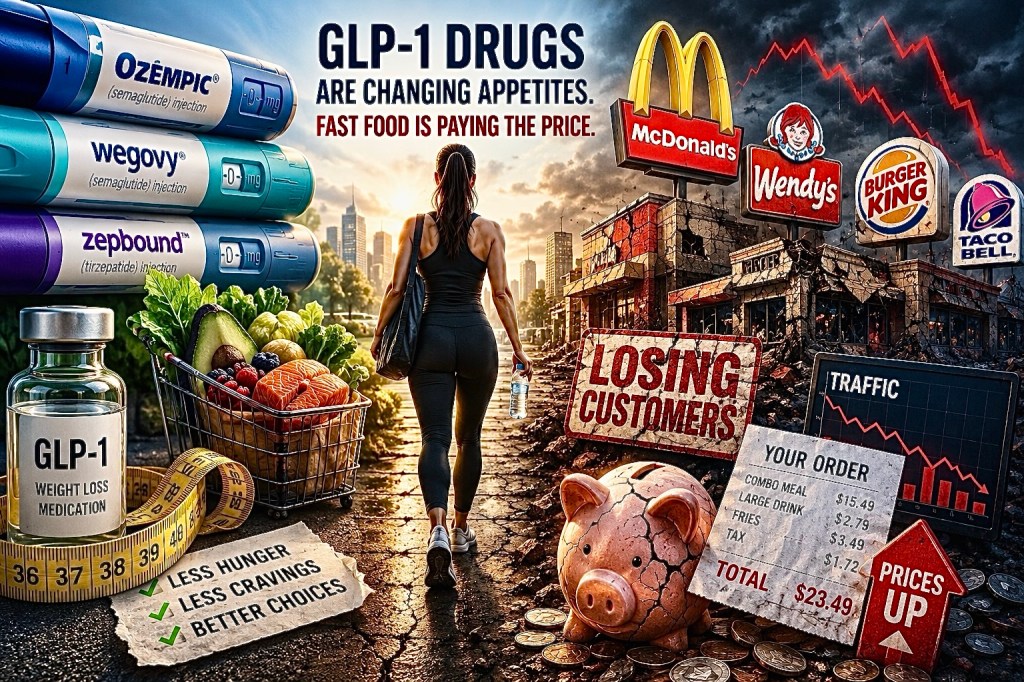
Not because America suddenly became disciplined, and not because people collectively embraced healthy eating, but because millions of Americans are now taking GLP-1 medications like Ozempic, Wegovy, and Zepbound, drugs that are fundamentally changing appetite, cravings, impulse behavior, and even the emotional relationship many people have with food.

Wall Street sees the shift and is pricing the market accordingly. Fast food executives definitely see it and they are freaking out!

Most public conversations around GLP-1 drugs focus on dramatic weight loss photos or pharmaceutical profits, but a much larger economic story is unfolding underneath the surface. Industries built around habitual American overconsumption are beginning to feel pressure, especially fast food chains that relied heavily on high frequency customers ordering large meals, sugary drinks, desserts, and late night convenience food multiple times per week.

Consumer data is already showing measurable changes. Studies using Numerator consumer spending data found GLP-1 users significantly reduced spending at fast food restaurants, grocery stores, snack categories, and coffee chains, particularly in areas tied to processed foods, sweets, chips, and impulse purchases.

That decline becomes dangerous when you understand how dependent these companies are on repeat customers with unhealthy eating habits.

McDonald’s recently reported weaker than expected U.S. traffic among lower income consumers, while executives acknowledged that many customers were pulling back spending because of financial pressure and changing consumption habits. Burger King, Wendy’s, Taco Bell, and other chains have faced similar traffic slowdowns, even while continuing to report billions in revenue.

But there is another layer to the story that receives far less attention.

Many of these companies quietly responded to slowing traffic and weaker customer volume by aggressively raising menu prices over the last several years, attempting to protect margins while fewer people were buying as frequently. In some markets, fast food prices increased so dramatically that consumers themselves started posting comparison photos online showing combo meals approaching $15 to $20, prices that would have sounded absurd only a few years ago, and are higher than sitting in a restaurant.

McDonald’s has faced widespread criticism over higher prices, especially after viral receipts showed basic meals costing nearly double what consumers remembered paying before the pandemic. Wendy’s faced backlash after discussions around dynamic pricing technology led many consumers to accuse the company of preparing “surge pricing” models similar to Uber, even though the company later clarified its intentions. Taco Bell, once viewed as one of America’s cheapest meal options, has increasingly been criticized online for charging premium prices for smaller portions, while Burger King has relied heavily on promotional bundles and limited time value deals to maintain traffic.

The problem for these companies is that price increases can temporarily offset declining volume, but they do not solve the underlying issue if consumer behavior itself is changing.

GLP-1 drugs interrupt consumption patterns at the neurological level.

Users consistently describe the experience as shutting down “food noise,” the nonstop mental pull toward eating, snacking, craving, and rewarding stress with consumption. Many people taking these medications are not simply eating less, they are losing interest in the entire ritual of excess eating that modern food marketing spent decades cultivating.

That creates a serious long term problem for industries whose products were intentionally engineered around dopamine response, convenience addiction, and repeat behavior. Fast food corporations have invested billions studying salt concentration, sugar ratios, aroma science, texture engineering, packaging psychology, and consumer reward loops because repeat cravings are where the real money has always been made.

Now pharmaceutical companies are profiting by suppressing the very appetites the processed food economy spent decades amplifying.

There is an uncomfortable irony in watching one corporate sector help fuel obesity rates while another sector becomes worth hundreds of billions treating the consequences of those same consumption patterns. America normalized ultra processed eating, oversized portions, and nonstop snacking for so long that many consumers forgot how unnatural some of those habits actually were.

Restaurant executives are already adapting.

Some chains are quietly shifting toward smaller portions, higher protein meals, and menu items designed to appeal to health conscious consumers and GLP-1 users, because they understand the market is changing faster than many analysts expected. Companies that once competed almost entirely on size, value meals, and excess calories are now experimenting with protein bowls, wraps, portion controlled items, and ingredient transparency.

And this shift is still in its early stages.

One in eight Americans currently use GLP-1 medications, yet the economic impact is already measurable enough that analysts, hedge funds, and corporate boards are discussing the long term implications across food, beverage, and restaurant industries. Analysts project the obesity drug market could exceed $100 billion annually within the next decade, numbers large enough to alter national consumption behavior at scale.

If these medications become cheaper, easier to access, and eventually available in pill form at mass scale, the consequences could move far beyond healthcare. Entire sectors of the American economy quietly depend on people continuing to overconsume, emotionally eat, impulse buy, and snack constantly. That reality becomes difficult to ignore once millions of consumers suddenly stop craving the products those industries were built around selling.

The deeper issue here is not really about weight loss. It is about what happens when consumers begin breaking patterns that corporations spent generations normalizing, monetizing, and reinforcing through advertising, convenience, engineered craving, and habit formation.

America did not merely create a fast food economy, it engineered an entire financial ecosystem around predictable human excess, where shareholders, supply chains, advertisers, and billion dollar corporations all quietly benefited from the assumption that consumers would continue eating emotionally, impulsively, and excessively for generations to come.

What makes the rise of GLP,1 drugs so disruptive is not simply that people are losing weight, it is that millions of consumers are beginning to break behavioral cycles that some of the largest industries in America spent decades studying, refining, and monetizing with scientific precision.

For the first time in modern American history, the industries that profited most from unlimited appetite are now confronting the possibility that appetite itself may no longer be dependable.

BlackRock Doesn’t Just Own Tech. It Owns Your Future.

BlackRock doesn’t just own parts of Apple, Microsoft, and Amazon. It owns your food supply. It owns farmland. It owns water infrastructure. And through those investments, it owns a growing stake in the future of human survival itself.

What began in 1988 as a modest Wall Street firm built on risk management is now the largest asset manager in human history. BlackRock controls over $11 trillion , which is larger than the GDP of every country in the world except the United States and China.

But what most people still don’t realize is that BlackRock’s most important power grab didn’t happen on Wall Street. It happened quietly, across America’s farmland, its food systems, and its natural resources.

How Did We Get Here?

BlackRock’s expansion strategy was never about flashy takeovers. It was about ownership without attention. They don’t need to buy entire companies when they can buy enough shares to influence them all.

Through complex index funds and ETFs (Exchange-Traded Funds), BlackRock has quietly become a top shareholder in nearly every major corporation in America. Coca-Cola. PepsiCo. Kraft Heinz. Nestlé. Tyson Foods. Monsanto-Bayer. Even the companies that compete with each other are often owned by the same hand, BlackRock.

That includes food production, packaging, seeds, fertilizers, pesticides, farmland, water rights, grocery store chains, and agribusiness suppliers.

It is a spider web so vast that very few industries operate outside of its reach.

Farmland: The New Oil

In recent years, farmland has quietly become one of the hottest investments among America’s wealthiest. But few players have been as aggressive as BlackRock and its peers like Vanguard and State Street.

Why Farmland you may ask?

Simple. Land produces food, controls water access, and holds its value against inflation. In a world of uncertainty, farmland is power.

BlackRock has invested in farmland directly and indirectly through real estate investment trusts (REITs) like Farmland Partners and Gladstone Land Corporation. In some regions, institutional investors now own an estimated 30-50% of all available farmland.

For local farmers like Paul Rettler, this creates an impossible game that no one can win. Competing against trillion-dollar firms backed by infinite capital means the consolidation of agriculture isn’t slowing down, rather it’s accelerating.

The ESG Illusion

Much of BlackRock’s public messaging has centered around ESG, which stands for: Environmental, Social, and Governance investing , a framework designed to steer money toward sustainable and ethical practices.

But behind the marketing, ESG has often allowed BlackRock to reshape industries while still investing heavily in the very corporations most responsible for environmental harm.

Larry Fink, BlackRock’s billionaire CEO, has framed ESG as both a moral obligation and a business necessity. Yet BlackRock remains one of the largest shareholders in fossil fuel giants, industrial agriculture companies, and food manufacturers responsible for deforestation and soil degradation.

As environmental groups have pointed out daily, BlackRock has the ability to change the food system overnight. But profit almost always wins over principle and we have seen this outcome time and time again.

So What Does BlackRock Want?

It’s simple: Control. Influence. Permanence.

The more essential needs a company controls such as food, water, housing, energy, the less it matters who holds political office. Ownership is the real power.

When a handful of corporations control the basic elements of survival, the public becomes renters of everything, including their health, their homes, and their future.

This is the world being built right in front of us.

Water rights in California. Farmland in the Midwest. Global seed patents. Packaging monopolies. Shipping routes. Grocery store chains. Pharmaceutical partnerships. Tech platforms controlling communication.

This is not just about selling products.

This is about owning life itself.

So what can everyday people do?

Waiting for a politician to fix this system is like waiting for a thief to return what they stole. It is not going to happen.

But the answer is not fear. The answer is awareness. The answer is action.

It starts with taking back control wherever you can.

Buy from local farmers when possible. Grow your own food even if it is just herbs in your kitchen window. Filter your water. Cook your own meals. Learn how to read ingredient labels. Support local businesses over corporations when you can.

Most importantly, do your own research. Step outside of Google, mainstream media, and the same recycled talking points coming from media companies owned by the very corporations profiting from your confusion.

Seek independent sources. Read books. Listen to people on the ground, not just those in boardrooms. Question convenience when it comes at the cost of your health.

Learn how to be less dependent on the systems designed to keep you dependent.

Because at this point, we cannot wait for RFK. We cannot wait for politicians. We cannot wait for the same people who helped build this system to suddenly tear it down.

We have to start building something different starting in our homes, in our families, in our communities.

Not because it is trendy.

But because survival has always belonged to the people willing to think for themselves, take responsibility for their lives, and protect their future by any means necessary.

The Quiet Poisoning of a Generation: How Food, Water, and Corporate Greed are Undermining Human Health

There’s something happening in our society and if you’ve felt it, you’re not alone.

More people are tired for no reason. Fertility rates are plummeting. Chronic illness is everywhere. Children face record levels of anxiety, allergies, and developmental issues. And yet, we’re told this is normal.

It’s not.

This is the byproduct of a system that has quietly (and quite profitably) waged war on human health.


Founded in 1988, BlackRock now controls over 10 trillion dollars in assets making it one of the most powerful financial forces on the planet.

Follow The Money, Find The Motive

Today, four corporations effectively control most of what you eat, drink, and absorb.

→ Bill Gates is now the largest private farmland owner in America.

→ BlackRock and Vanguard own massive stakes in Monsanto, Nestlé, PepsiCo, Kellogg’s, and Beyond Meat.

→ Lab-grown meat is no longer science fiction, it’s a funded inevitability.

→ The same companies poisoning your body with seed oils, synthetic additives, and plastic packaging? They own the pharmaceutical firms selling you the cure.

This is not a conspiracy — it’s strategy.

When you own the food, the water, the farmland, the grocery distribution, and the healthcare response, you don’t need to control people with force.

You control them with dependence.

What’s Happening To Us?

Consider this:

Global sperm counts have dropped 50% since the 1970s. Testosterone levels in men are down 30% in 20 years. Microplastics are now found in human bloodstreams, breast milk, and even placentas. “Forever chemicals” (PFAS) are in 98% of the U.S. population. The CDC now quietly admits fluoride in water, while good for teeth in small doses, can impact brain development at high levels.

If this were isolated, it could be coincidence.

But when it’s everywhere like our water, food, packaging, cosmetics, medicine, even the air, you start to realize: This is systemic.

The Long Game: Weaken the Body, Profit from the Cure

Sick people buy more products.

Infertile couples pay more for solutions.

Distracted, inflamed, chemically-dependent populations don’t resist systems, they survive within them.

And while many are waiting for politicians like RFK Jr. to come in and blow the whistle, the reality is clear:

This system is working exactly as designed.

So What Do We Do?

Here’s the truth: No one is coming to save us.

But there is power in knowing how to exit the trap.

Real Alternatives for Real People:

Filter your water using Berkey, Clearly Filtered, or AquaTru. Eat whole, organic, ancestral foods with a focus on local sources first. Cut seed oils completely and cook with avocado oil, olive oil, or ghee. Limit plastic exposure by using stainless steel, glass containers, and beeswax wraps. Get daily sunlight and move your body because nature was the original medicine. Supplement wisely to rebuild minerals and support safe detoxing. Support local farmers instead of large corporations whenever possible. Learn herbal medicine like black seed oil, seamoss, milk thistle, and dandelion root. Sweat daily through sauna sessions, hot yoga, or hard workouts. Reduce pharmaceutical dependence by healing the root cause, not just managing symptoms.

Final Thought

We can’t wait for RFK. We can’t wait for “them” to fix what they profit from breaking.

We have to take back our health. Ourselves. Today.

Not because it’s trendy.

Not because it’s easy.

But because our future depends on it.

Health is no longer a luxury, it’s a form of resistance.

This is how we fight back.

Harvard Expands Free Tuition to Families Earning Under $200,000

By Nkozi Knight

In a move aimed at expanding access to higher education, Harvard University announced Monday that it will offer free tuition to students from families earning $200,000 or less starting in the 2025-2026 academic year. This marks a significant expansion of the university’s financial aid program, further removing financial barriers for prospective students.

Students from families with incomes below $100,000 will also have all expenses covered, including housing, food, health insurance, and travel costs. Previously, Harvard provided full financial support only to students from families earning less than $85,000 annually.

“Putting Harvard within financial reach for more individuals widens the array of backgrounds, experiences, and perspectives that all of our students encounter, fostering their intellectual and personal growth,” said Harvard President Alan Garber.

While tuition alone at Harvard currently exceeds $56,000, total costs, including housing and other fees, approach $83,000 per year. The new policy will significantly lessen that burden for many American families.

Families earning above $200,000 may still qualify for tailored financial aid depending on individual circumstances.

This initiative aligns with similar policies at other elite institutions, like the Massachusetts Institute of Technology (MIT), which announced a comparable expansion last fall. Harvard estimates that 86% of U.S. families will now be eligible for some level of financial aid.

“Harvard has long sought to open our doors to the most talented students, no matter their financial circumstances,” said Hopkins Dean of the Faculty of Arts and Sciences. “This investment ensures that every admitted student can pursue their academic passions and contribute to shaping our future.”

The expansion comes amid broader conversations about diversity in higher education, especially following the Supreme Court’s ruling against affirmative action in college admissions. Harvard, along with other institutions like the University of Pennsylvania, views increased financial aid as a pathway to maintaining diversity by ensuring access to students from varied socioeconomic backgrounds.

“We know the most talented students come from different socioeconomic backgrounds and experiences, from every state and around the globe,” said William Fitzsimmons, Harvard’s dean of admissions and financial aid. “Our financial aid is critical to ensuring that these students know Harvard College is a place where they can thrive.”

This policy marks a continued effort to create a more inclusive and accessible environment at one of the nation’s most prestigious universities.

The Silent Killer: How Our Diet and Lifestyle Are Shortening Our Lives

By Nkozi Knight

I truly thought I was healthy. My BMI is only 25, and by most accounts, I look like I I am in great shape. But something wasn’t right for weeks. I felt tired all the time, my feet tingled, and my energy levels were nowhere near what they used to be when I would workout. Something inside me told me to get checked out, and what I found was alarming:

A1C: 7.3% → Diabetes confirmed

LDL (“bad” cholesterol): 198 mg/dL → Very high

Non-fasting glucose: 219 mg/dL → Dangerously high

In other words, I was walking around with a silent killer inside me, completely unaware. And I’m not alone.

Black Men and the Health Crisis No One Talks About

Black men in the United States are disproportionately affected by diabetes, high blood pressure, heart disease, blood clots, and amputations, a lot of it comes down to our diet, lifestyle, and neglect of medical care. Here are some statistics that speak to that point:

Black adults are 60% more likely to be diagnosed with diabetes than white adults (CDC, 2022).

More than 40% of Black men have high blood pressure, increasing the risk of heart attack and stroke (American Heart Association, 2023).

• Diabetes-related amputations occur nearly 3 times more often in Black patients than in white patients (JAMA, 2021).

Yet, we don’t talk about it. We recently witnessed super dad, Lavar Ball lose his foot from such complications. We brush off the fatigue, the numbness, the tingling, the headaches, the difficulty in the bedroom, and the shortness of breath as just “getting older.” But these are warning signs that something is seriously wrong.

The Warning Signs You Can’t Ignore

Tingling or numbness in your feet → Early sign of diabetic neuropathy, which can lead to amputation if untreated.

Extreme fatigue → Could be due to high blood sugar, poor circulation, or even heart disease.

Erectile dysfunction (ED) → Often an early symptom of diabetes or heart disease due to damaged blood vessels.

Blurry vision → High blood sugar can lead to diabetic retinopathy, which can cause blindness.

Slow-healing wounds → A sign of poor circulation, increasing the risk of infections and amputations.

• Frequent urination & constant thirst → Classic symptoms of diabetes.

If you’re experiencing any of these symptoms, it’s time to see a doctor immediately.

Fast Food & High Sugar Diets Are Killing Us

Let’s be real. Our beautiful culture is built around food, and not just any food, it always fried chicken, snacks, barbecue, mac and cheese, burgers, energy drinks, and other sugar-loaded drinks. We love to eat (at least I do), and food is a part of our identity. But it’s also the reason why we’re dying younger than we should.

The average American consumes 17 teaspoons of added sugar per day which far beyond the recommended limit of 9 teaspoons for men (American Heart Association, 2023).

Black Americans are more likely to consume sugar-sweetened beverages, which are directly linked to diabetes and heart disease (CDC, 2022).

Red meat and processed meats (bacon, sausage, deli meat) increase the risk of heart disease by 18% and diabetes by 12% (Harvard School of Public Health, 2023).

The Solution: Skip the Steak, Choose the Chicken

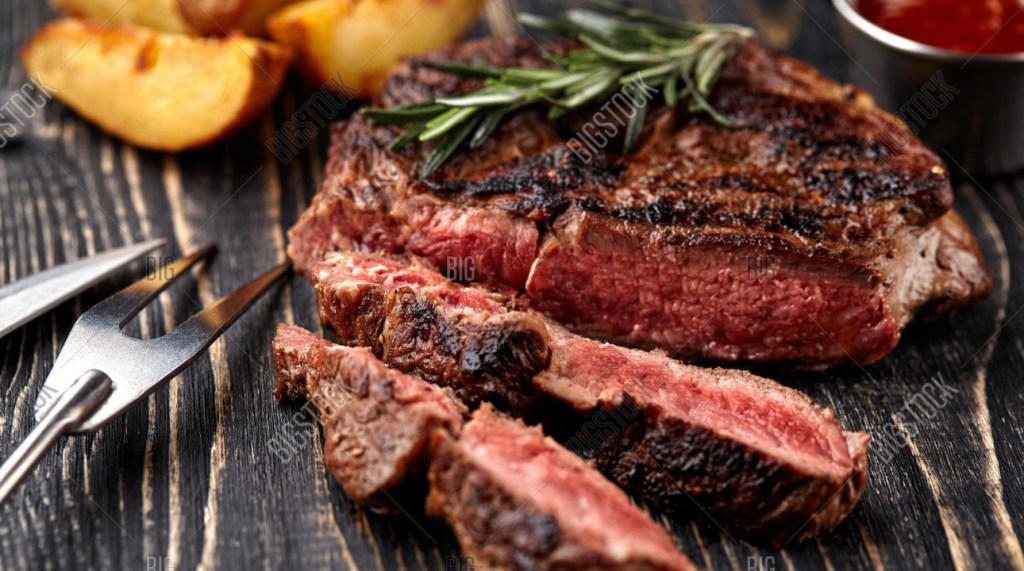
I used to be that guy….grabbing a burger and fries on the go, ordering a steak just because I could, and washing it all down with a Sprite or Old Fashioned. But after seeing my numbers, I realized I was digging my own grave, and I have too many people depending on me to check out early.

I made the switch, and I urge you to do the same:

No more red meat → Choose grilled chicken, turkey, or fish instead.

No more sugary drinks → Drink water, unsweetened tea, or black coffee.

No more processed carbs → Swap white bread & pasta for whole grains like quinoa & brown rice.

More fiber, more greens, more movement.

And most importantly, please see a doctor before it’s too late.

Your Health Is in Your Hands

Black men, we can’t afford to ignore our health any longer. We too often put our own needs aside to take care of everyone else to our own demise. Too many of us are losing limbs, suffering strokes, and dying before our time. It’s not genetics at all, it’s the choices we make every day.

If you made it this far I ask you to not wait until it’s too late. Get your bloodwork done, eat like your life depends on it (because it does), and start moving.

We all deserve longer, healthier lives but we have to take action to make that a reality. I thank God for the people in my life who encouraged me to get checked out before it was too late, because too many of us ignore the warning signs until we can’t anymore. Let’s hope the MAHA movement brings attention to this silent killer that’s taking too many of us too soon. Our health is our responsibility so let’s fight for it.

Sources:

• CDC. (2022). Diabetes Statistics in the U.S.

• American Heart Association. (2023). Heart Disease & Stroke Risk in African Americans.

• Harvard School of Public Health. (2023). The Impact of Diet on Chronic Diseases.

• JAMA. (2021). Racial Disparities in Diabetes-Related Amputations.