By Nkozi Knight
For decades, the American fast food industry perfected a business model centered around excess, not occasional indulgence but routine overconsumption, where ridiculously enormous portions, bio-engineered flavors, aggressive marketing, and nonstop convenience created customers who returned multiple times a week, sometimes multiple times a day. The industry’s biggest profits never came from the family grabbing fries after a basketball game, they came from repeat customers whose habits became predictable revenue streams because they had no self control.
Now those customers and their waistlines are quietly disappearing.
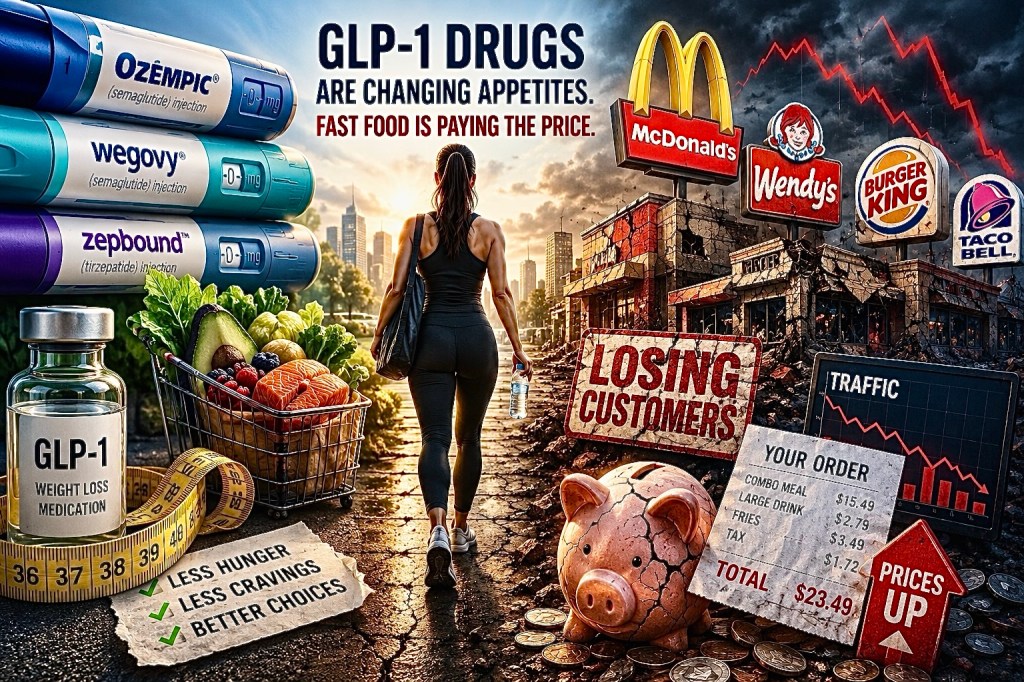
Not because America suddenly became disciplined, and not because people collectively embraced healthy eating, but because millions of Americans are now taking Glucagon-Like Peptide-1 more commonly referred to as GLP-1 medications like Ozempic, Wegovy, and Zepbound, drugs that are fundamentally changing appetite, cravings, impulse behavior, and even the emotional relationship many people have with food.
Wall Street sees the shift and is pricing the market accordingly. Fast food executives definitely see it and they are freaking out!
Most public conversations around GLP-1 drugs focus on dramatic weight loss photos or pharmaceutical profits, but a much larger economic story is unfolding underneath the surface. Industries built around habitual American overconsumption are beginning to feel pressure, especially fast food chains that relied heavily on high frequency customers ordering large meals, sugary drinks, desserts, and late night convenience food multiple times per week.
Consumer data is already showing measurable changes. Studies using Numerator consumer spending data found GLP-1 users significantly reduced spending at fast food restaurants, grocery stores, snack categories, and coffee chains, particularly in areas tied to processed foods, sweets, chips, and impulse purchases.
That decline becomes dangerous when you understand how dependent these companies are on repeat customers with unhealthy eating habits.
McDonald’s recently reported weaker than expected U.S. traffic among lower income consumers, while executives acknowledged that many customers were pulling back spending because of financial pressure and changing consumption habits. Burger King, Wendy’s, Taco Bell, and other chains have faced similar traffic slowdowns, even while continuing to report billions in revenue.
But there is another layer to the story that receives far less attention.
Many of these companies quietly responded to slowing traffic and weaker customer volume by aggressively raising menu prices over the last several years, attempting to protect margins while fewer people were buying as frequently. In some markets, fast food prices increased so dramatically that consumers themselves started posting comparison photos online showing combo meals approaching $15 to $20, prices that would have sounded absurd only a few years ago, and are higher than sitting in a restaurant.
McDonald’s has faced widespread criticism over higher prices, especially after viral receipts showed basic meals costing nearly double what consumers remembered paying before the pandemic. Wendy’s faced backlash after discussions around dynamic pricing technology led many consumers to accuse the company of preparing “surge pricing” models similar to Uber, even though the company later clarified its intentions. Taco Bell, once viewed as one of America’s cheapest meal options, has increasingly been criticized online for charging premium prices for smaller portions, while Burger King has relied heavily on promotional bundles and limited time value deals to maintain traffic.
The problem for these companies is that price increases can temporarily offset declining volume, but they do not solve the underlying issue if consumer behavior itself is changing.
GLP-1 drugs interrupt consumption patterns at the neurological level.
Users consistently describe the experience as shutting down “food noise,” the nonstop mental pull toward eating, snacking, craving, and rewarding stress with consumption. Many people taking these medications are not simply eating less, they are losing interest in the entire ritual of excess eating that modern food marketing spent decades cultivating.
That creates a serious long term problem for industries whose products were intentionally engineered around dopamine response, convenience addiction, and repeat behavior. Fast food corporations have invested billions studying salt concentration, sugar ratios, aroma science, texture engineering, packaging psychology, and consumer reward loops because repeat cravings are where the real money has always been made.
Now pharmaceutical companies are profiting by suppressing the very appetites the processed food economy spent decades amplifying.
There is an uncomfortable irony in watching one corporate sector help fuel obesity rates while another sector becomes worth hundreds of billions treating the consequences of those same consumption patterns. America normalized ultra processed eating, oversized portions, and nonstop snacking for so long that many consumers forgot how unnatural some of those habits actually were.
Restaurant executives are already adapting.
Some chains are quietly shifting toward smaller portions, higher protein meals, and menu items designed to appeal to health conscious consumers and GLP-1 users, because they understand the market is changing faster than many analysts expected. Companies that once competed almost entirely on size, value meals, and excess calories are now experimenting with protein bowls, wraps, portion controlled items, and ingredient transparency.
And this shift is still in its early stages.
One in eight Americans currently use GLP-1 medications, yet the economic impact is already measurable enough that analysts, hedge funds, and corporate boards are discussing the long term implications across food, beverage, and restaurant industries. Analysts project the obesity drug market could exceed $100 billion annually within the next decade, numbers large enough to alter national consumption behavior at scale.
If these medications become cheaper, easier to access, and eventually available in pill form at mass scale, the consequences could move far beyond healthcare. Entire sectors of the American economy quietly depend on people continuing to overconsume, emotionally eat, impulse buy, and snack constantly. That reality becomes difficult to ignore once millions of consumers suddenly stop craving the products those industries were built around selling.
The deeper issue here is not really about weight loss. It is about what happens when consumers begin breaking patterns that corporations spent generations normalizing, monetizing, and reinforcing through advertising, convenience, engineered craving, and habit formation.
America did not merely create a fast food economy, it engineered an entire financial ecosystem around predictable human excess, where shareholders, supply chains, advertisers, and billion dollar corporations all quietly benefited from the assumption that consumers would continue eating emotionally, impulsively, and excessively for generations to come.
What makes the rise of GLP,1 drugs so disruptive is not simply that people are losing weight, it is that millions of consumers are beginning to break behavioral cycles that some of the largest industries in America spent decades studying, refining, and monetizing with scientific precision.
For the first time in modern American history, the industries that profited most from unlimited appetite are now confronting the possibility that appetite itself may no longer be dependable.

 Nkozi Knight