Private Equity’s Greed Is Catching Up: Why Ordinary Americans Will Pay the Price

April 30, 2025 • By NKOZI KNIGHT

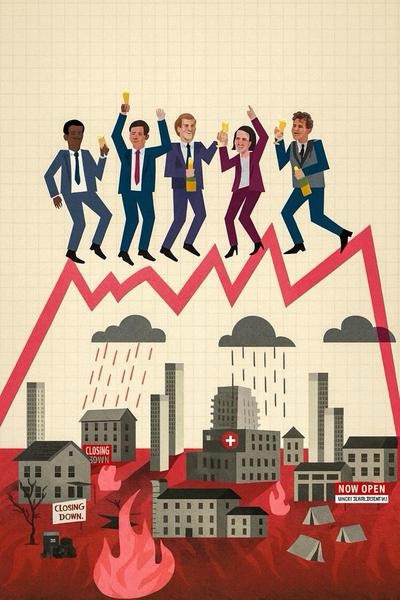
Many of us do not realize that private equity firms has always been about extraction, not creation. The model is simple. Borrow heavily, buy a company, slash jobs and benefits, sell off assets, and walk away with fees long before the damage shows. Communities are left with shuttered stores, abandoned buildings, bankrupt chains, and broken promises.

The list of casualties is long. Toys “R” Us was loaded with more than $5 billion dollars in debt by Bain Capital and KKR before it collapsed, taking 30,000 jobs with it. Payless ShoeSource closed its doors, erasing 18,000 jobs. J. Crew, Gymboree, Shopko, Forever 21, and Sears each followed the same path. Behind nearly every failure was a private equity deal that turned once-profitable companies into vehicles for debt. Blackstone, the largest of them all, drew criticism for gutting nursing homes and rental housing, where residents and tenants bore the consequences. Carlyle, Apollo, and Sycamore Partners engineered deals that enriched executives while leaving behind bankruptcies across retail, energy, and health care.

The damage has never been limited to debt. Private equity firms extract billions in fees on top of what they load onto companies. They sell the land and buildings, forcing the very businesses they own to pay rent back to them. In franchise models, they skim off royalty payments while cutting services and staff. They charge management fees to companies they already control, ensuring that even if a business fails, the firm still profits. These practices are not side effects. They are the business model.

For years the system ran on cheap money. With interest rates near zero, debt was abundant and investors were eager. Firms could buy, bleed, and flip companies in two or three years. That era is gone. Interest rates now sit above five percent. Debt costs more, buyers are scarce, and the IPO market has dried up. Firms are stuck holding companies that are drowning under the very leverage designed to enrich their owners.

The numbers are staggering. Nearly $12 trillion dollars in private equity assets now sit unsold. Exit activity has collapsed more than 70 percent since 2021. To raise cash, firms are borrowing against their own portfolios with NAV loans or dumping stakes at steep discounts on the secondary market. Even the giants like Blackstone, KKR, Apollo, Carlyle, Bain are stuck with bad debt no one wants. They cannot sell, yet their investors are demanding cash.

The quiet truth is that these firms are already maneuvering for Washington’s help. During the 2008 financial crisis, banks and insurers were rescued with taxpayer dollars. Private equity, which profited handsomely off that same collapse, is positioning itself for similar treatment.

This is not just an elite problem. It is a national one. When private equity runs out of road, it is not the billionaire partners who suffer. It is the workers whose jobs are cut, the retirees whose pensions cannot meet obligations, the students whose tuition rises because endowments cannot keep pace, and the taxpayers who are asked to backstop the system.

The parallels to 2008 are frightening. Then it was mortgage backed securities. Now it is unsellable companies and illiquid funds. In 2008, families lost homes and jobs while Wall Street was saved. Today the scale is even larger. With trillions in assets frozen, the next bailout could dwarf the last one.

Meanwhile, private equity’s destruction also extends into America’s hospitals and nursing homes and people are paying with their lives. Studies show that Medicare patients undergoing emergency surgeries in private equity–owned hospitals are 42 percent more likely to die within 30 days compared to those treated in community hospitals . A nationwide study found infections, falls, and other preventable adverse events increased following private equity takeovers of hospitals . Even the U.S. Department of Health and Human Services condemned the impact, warning that private equity ownership of nursing homes led to an 11 percent increase in patient deaths .

Recent reporting shows the financial calculus behind these tragedies. Nursing home operators in New York’s Capital Region diverted Medicare and Medicaid funds through inflated rent and bogus salaries. That left facilities chronically understaffed and suffering neglect so severe that it led to cases of serious injury and death .

By turning hospitals and nursing homes into profit centers rather than care centers, private equity firms aren’t just bankrupting businesses, they are literally killing people. And when that business model collapses, it will be everyday Americans who pay the cost once again.

The message is not subtle. If private equity’s gamble fails, the richest players will once again be saved. For ordinary Americans, the reckoning will look like it always does. Lost jobs. Higher taxes. Vanishing pensions. Rising tuition. And another generation paying for someone else’s greed.

This is the American cycle. The profits are privatized, the losses are socialized, and working families are forced to carry the cost.


While You’re Watching Game 7 of the NBA Finals, We’re Being Sold Out Piece by Piece

We’re not watching a dramatic fall of America. There are no breaking news alerts about the end. No explosions in the streets. No economic sirens.

But make no mistake….something terrible is happening.

Piece by piece, decision by decision, we are being sold out. Our labor, our taxes, our future, it is all being extracted. And while it happens, we are told to look the other way while letting AI take many of our jobs.

Watch the game. Scroll the feed. Place a bet. Argue online about culture wars that do not affect your rent, your hospital bill, or your ability to afford groceries.

Meanwhile, the money keeps flowing. Out of your paycheck. Out of your neighborhood. Out of this country. Straight into the hands of foreign governments, defense contractors, and elite interests.

This is not the dramatic fall of a nation. It is a transfer of wealth, security, and stability away from ordinary Americans and toward a system that was never built to serve us. It is a system that acts globally, extracts locally, and survives only as long as we do not look directly at it.

You can call it a government. You can call it a machine. But what it really functions as is an empire. And the longer we ignore it, the more it takes.

The Cost of That Empire Is Being Paid in Evictions and Empty Refrigerators

While your tax dollars are used to fund missile systems in Israel, people across the United States are struggling just to keep a roof over their heads. Since 2020, the median price of a home has risen by more than 40 percent. Interest rates have climbed above 7 percent, making homeownership unreachable for millions (National Association of Realtors, 2024).

At the same time, Americans like myself, carry over $1.7 trillion in student loan debt. Medical bankruptcies remain the most common form of personal financial ruin. A premature baby that has to stay in a neonatal intensive care unit for over a month can cost well over a million dollars. On top of that, more than half of the country cannot afford an unexpected five hundred dollar emergency.

And yet, every year, tens of billions of dollars are approved for foreign aid without hesitation.

Israel receives more U.S. taxpayer money than any other nation on Earth. Since 1948, it has received over 300 billion dollars in aid, including nearly 4 billion annually in guaranteed military funding (Congressional Research Service, 2023).

That money has helped fund a public healthcare system, subsidized childcare, and modern infrastructure. Israel’s students have new schools. Their citizens have access to doctors without going bankrupt.

Meanwhile, in American cities, teachers work second jobs. Classrooms go without books. People drive across state lines to afford prescriptions. And in cities like Flint, Michigan and Jackson, Mississippi, families still live without safe drinking water.

This is not about scarcity. It is about priorities.

An Economy Built to Keep Us Consuming

We are told that the economy is doing well. But it only looks strong on paper because we are constantly spending to survive.

Wages have remained flat for decades, while the cost of everything else has gone up. Food, gas, housing, tuition, and insurance have all exploded. But instead of fixing the system, the solution we are offered is more debt.

Buy now, pay later.

Zero percent financing.

Monthly subscriptions for everything, even the essentials.

Our economy runs on credit cards and desperation.

We are not building wealth. We are surviving one paycheck at a time, and no one is willing to admit it.

And when that stress becomes too much, we are handed another solution, a distraction. Sometimes it’s a RICO case of a famous celebrity, other times it’s the United States bombing an empty nuclear facility in Iran, and other times it’s something as simple as sports and sports betting.

There is always something to pull our focus. Sports betting is now a multi-billion dollar industry thanks to ESPN, Draft Kings, Prize Picks, and MGM Sports betting. On television, sex-laden reality shows dominate prime time and paid subscriptions. Viral celebrity drama trends daily. Meanwhile, airstrikes in Gaza or explosions in Tehran are buried beneath all this noise but we pay for all of it.

None of this is random. It is a carefully designed system.

We Fund a Better Life for Others While We Are Told to Settle for Less

The average American is constantly being told to sacrifice.

Tighten your belt.

Use credit.

Be patient.

Inflation is temporary.

Work harder.

But there is no austerity when it comes to military aid.

There is always money for war. There is always money for foreign governments. There is always money to rebuild somewhere else in a land most have never been, but there is nothing for Maui, East Palestine, Flint, New Orleans, and many other cities in America.

Since 1948, Israel has received over 300 billion dollars in U.S. assistance (Reuters, 2024). That money has helped create one of the best publicly funded healthcare and education systems in the world—for a country with fewer people than New York City.

In America, we have veterans sleeping on the street in every major city.

We have kids learning from worksheets because their school cannot afford books.

We have families rationing insulin and choosing between medication and rent.

This is not just a funding issue. It is a values issue.

We are paying for the stability of others while our own communities are crumbling.

They Keep Us Distracted So We Do Not See It

Every time the conversation gets too close to real issues, the distractions flood in.

The headlines suddenly shift, and Operation Mockingbird goes full tilt. The scandals erupt more salacious than the prior one. The outrage machine gets turns on, and Americans are pinned against each other.

We are told to obsess over celebrities, argue over culture wars, and follow political soap operas like they are sports teams.

This is not a coincidence. It is the only way this corrupt system survives.

Because if we stop fighting each other, we might start asking the real questions.

Where is the money going?

Why can’t we afford basic services while funding foreign militaries?

Why is our economy built on debt and distraction?

And who exactly is benefiting from all of this since it’s not US?

This Is Not Incompetence. It Is a Strategy.

The truth is that the United States has all the resources it needs to take care of its people….if it wanted to.

But we do not. Not because we can’t. But because we are not supposed to.

We are expected to work, consume, and remain distracted.

We are expected to stay tired, stay anxious, and stay divided.

And we are expected to believe that any attempt to change the system is unrealistic, unpatriotic, or impossible.

But the truth is, the system is not broken. It is functioning exactly as designed.

It is designed to take.

It is designed to distract.

And it is designed to leave us wondering why we are doing everything right and still falling behind.

Can You Relate

If you are working harder than ever but getting nowhere, you are not alone.

If you are wondering why another country has healthcare and you cannot afford a routine checkup, you are asking the right question.

If you are tired of being told that sacrifice is patriotic while billionaires and foreign allies get blank checks, then maybe it is time we stop playing along.

They do not fear Iran. They do not fear China. They do not fear Russia.

What they fear is that you will start paying attention.

Because the moment we stop watching the show and start watching the system, the game is over.

Sources

National Association of Realtors. (2024). Median home price trends

Congressional Research Service. (2023). U.S. Foreign Aid to Israel

Reuters. (2024). Israel aid totals and annual packages

CNBC. (2023). 80 percent of Americans live paycheck to paycheck

Cato Institute. (2021). U.S. Military Footprint: 750 bases in 80 countries

Al Jazeera. (2021). U.S. global base presence overview

Harvard Expands Free Tuition to Families Earning Under $200,000

By Nkozi Knight

In a move aimed at expanding access to higher education, Harvard University announced Monday that it will offer free tuition to students from families earning $200,000 or less starting in the 2025-2026 academic year. This marks a significant expansion of the university’s financial aid program, further removing financial barriers for prospective students.

Students from families with incomes below $100,000 will also have all expenses covered, including housing, food, health insurance, and travel costs. Previously, Harvard provided full financial support only to students from families earning less than $85,000 annually.

“Putting Harvard within financial reach for more individuals widens the array of backgrounds, experiences, and perspectives that all of our students encounter, fostering their intellectual and personal growth,” said Harvard President Alan Garber.

While tuition alone at Harvard currently exceeds $56,000, total costs, including housing and other fees, approach $83,000 per year. The new policy will significantly lessen that burden for many American families.

Families earning above $200,000 may still qualify for tailored financial aid depending on individual circumstances.

This initiative aligns with similar policies at other elite institutions, like the Massachusetts Institute of Technology (MIT), which announced a comparable expansion last fall. Harvard estimates that 86% of U.S. families will now be eligible for some level of financial aid.

“Harvard has long sought to open our doors to the most talented students, no matter their financial circumstances,” said Hopkins Dean of the Faculty of Arts and Sciences. “This investment ensures that every admitted student can pursue their academic passions and contribute to shaping our future.”

The expansion comes amid broader conversations about diversity in higher education, especially following the Supreme Court’s ruling against affirmative action in college admissions. Harvard, along with other institutions like the University of Pennsylvania, views increased financial aid as a pathway to maintaining diversity by ensuring access to students from varied socioeconomic backgrounds.

“We know the most talented students come from different socioeconomic backgrounds and experiences, from every state and around the globe,” said William Fitzsimmons, Harvard’s dean of admissions and financial aid. “Our financial aid is critical to ensuring that these students know Harvard College is a place where they can thrive.”

This policy marks a continued effort to create a more inclusive and accessible environment at one of the nation’s most prestigious universities.

What Emmett Till’s Mother Taught Me About Grief and Justice

On Feb. 26, 2012, my entire life changed in ways that I could never imagine. Within an instant, after the brutal and inhumane killing of my son, …

What Emmett Till’s Mother Taught Me About Grief and Justice

Five ways of expanding your business internationally

The global economy is changing thanks to worldwide connectivity. Companies across the globe are communicating with others without delays or hassles …

Five ways of expanding your business internationally

Powerful Conversations: How High-Impact Leaders Communicate

iStock_000015269756XSmall[1].jpg

All leaders talk, but it is what they say and how they say it that determines whether the group succeeds or fails.

Think about it: the leader’s most fundamental and most important job is to be in touch with those around him or her. Whether it is in the hallways or on the phone, in the middle of the workday or after hours, while delivering a performance review to a key employee or a yearly address to thousands of employees, leaders are involved in a constant series of conversations.

Through these encounters, whether brief and spontaneous or scheduled and structured, leaders try to use their time with colleagues, employees, customers, and others to reach a variety of ends. Grabbing a moment, the leader takes the opportunity to influence and direct a member of the sales staff. A weekly meeting becomes a chance to coach a manager and gather information about the department’s morale and its financial numbers. A quick e-mail checks on the progress of a research project and gives a boost of recognition and support to the team. During a strategy meeting, the leader negotiates next steps with division heads and outlines a coordinated approach. At a company awards ceremony, he or she tries to hammer home a message about values and goals. In short, the leader, through his or her conversations, aims to foster relationships, build support networks, and sharpen organizational focus.

Yet outcomes from conversations are too often unclear. Perceptions don’t always match. Influences are frequently not as profound as one would hope. Communication is generally a struggle with mixed, uncertain, and unpredictable results. Too much conversation is ad hoc and hinges on moods, energy levels, relationships, and personalities. Sometimes a leader is right on point. Sometimes he or she clicks and forges a new connection. Other times, the leader misses the mark. Either way, he or she pushes on, lining up the next meeting, setting up the next goal, responding to the latest need for clarification.

Communication is never easy. Inevitably, when a leader is driving change and dealing with conflicting agendas, some conversations provide a challenge that tests the bounds and skill of experience. During the heat of a difficult conversation, you need to fall back on a discipline. You need clear communication that advances agendas, promotes learning, and strengthens relationships. It’s the difference between achieving objectives and having everything fall apart—and the difference between winning and losing.

Imagine having to let a close friend know that he or she is off a project because of poor performance, yet wanting at the same time to preserve the strength of the relationship. Imagine having to make necessary structural changes to an organization, realigning roles and positions in ways that involve cuts in the workforce, yet wanting at the same time to bolster morale and organizational commitment. These are the difficult conversations that High-Impact Leaders face every single day, so what makes them different from any other leader?

High-Impact Leaders are the people who get results. They are the ones who make things happen. They are the leaders who are able to continually advance a clear agenda, get others to buy into it, and move an organization, a division, or a team forward. Being a High-Impact Leader has nothing whatsoever to do with title or rank, because High-Impact Leaders can be found up, down, and across any organization.

-Impact Leaders are the ones who cause no surprises. They are explicit, consistent, concise, and authentic. They sometimes have an abundance of charisma, but that is clearly not a prerequisite. More to the point, High-Impact Leaders are the ones who take charge wherever they are. They are the ones others want to follow. They are also the leaders whose teams others consistently want to join. When they move on to new roles or new territories, they do not travel alone. Others ask to go with them.

These conditions result because High-Impact Leaders use the technology of Powerful Conversations and then match what they say with what they do. Through Powerful Conversations, they develop openness, honesty, and clarity in order to get others to believe and share in their goals, to gain commitments, and to foster trust. And they prove they are worthy of that trust by delivering on their own commitments and by making results happen.

The link between Powerful Conversations and High-Impact Leaders lies in the relationship between two concepts I refer to as Say and Do. I have seen people skilled at the art of Powerful Conversations nevertheless fail as leaders because they fail to live up to their words. As a result, they never become High-Impact Leaders. I have never known a High-Impact Leader, however, who was not also skilled at Powerful Conversations, whether conscious of that designation or not. To be a High-Impact Leader, you have to be able to conduct Powerful Conversations on a consistent basis and live up to the outcomes of those conversations. Why is this important? It has to do with trust—without which conversations cannot progress toward the realization of commitments.

One of the most important functions of a Powerful Conversation is to create clarity, a critical success factor for building trust. I cannot tell you how frequently I have been involved in situations in which a leader, reflecting on problems that have arisen, says, “I can’t believe they thought I meant that. I never had any intention of doing that.” And the followers say something like, “It’s unbelievable. Our leader made a clear commitment to do this and now denies it was ever part of the agenda.” Both sides shake their heads. Barriers go up. Trust is reduced or nonexistent.

True clarity implies that a leader says exactly what he or she means in such a way that his or her statements are received as intended. This requires openness, honesty, and an active and careful tracking of wants, needs, and commitments. It furthermore requires that those clear statements be lived up to with demonstrated actions built on organizational trust.

High-Impact Leaders today lead in a better way because they recognize that the shortest path to achieving objectives is to build trust and gain clear commitments from others. Specifically, they engage in Powerful Conversations to uncover the wants and needs of others in order to understand what will motivate those people to join forces with the leader and live up to the commitments of a conversation. They skillfully orchestrate the Powerful Conversations in which they engage to make clear all parties understand the exact commitments that have been made. Then they check into those commitments and make sure through follow-up conversations that the commitments can be kept. They track the wants and needs of others and find ways to reinforce their own desire to understand the wants and needs of others, often through continued follow-up conversations. High-Impact Leaders do these things because they know that trust must exist if the leader is to achieve his or her agenda through Powerful Conversations to create positive outcomes for their teams and stakeholders.

by Phil Harkins