Ironheart and the Betrayal of Storytelling


Riri Williams, Ironheart, stands beside her armor modeled after Iron Man, a symbol of the genius and potential that Marvel’s adaptation failed to honor.

When Marvel introduced Riri Williams in Black Panther: Wakanda Forever, she felt like a revelation. A young Black genius, bold and quick-witted, standing confidently beside Shuri and Wakanda’s leaders, she radiated promise. Audiences believed she was destined to inherit the mantle of brilliance that Tony Stark left behind.

The Disney Plus series Ironheart undid all of that. Rather than elevating Riri’s genius, the show stripped her down and leaned on clichés. Instead of building an earned character arc, Marvel forced one, and when audiences rejected it, Disney did not admit the problem was storytelling. It turned on its own fans, deflecting fair criticism as misogyny or racism. That response only deepened the sense of betrayal.

What made Ironheart sting was not representation but its absence of authentic narrative. Riri’s journey was reactive rather than inventive, her brilliance muted to the point where she seemed less capable than in Black Panther 2. Her supporting cast was too thin to provide depth, leaving Dominique Thorne to carry scenes without the balance that seasoned actors could have offered. This was the opposite of what Marvel did with Tom Holland’s Spider-Man, where young talent was elevated by veterans like Robert Downey Jr. and Michael Keaton. In Ironheart, there was no gravitas to steady her.

The most glaring missed opportunity was the arc itself. In the comics, Riri is mentored by Tony Stark’s AI, a natural continuation of Iron Man’s legacy and a relationship that challenges her intellect. That arc was abandoned in favor of an AI woman who felt more like a nagging caricature than a mentor. It was meant to look progressive, but it flattened Riri even further. Instead of sharpening her genius through real tests, the show reduced her to tropes and sidelined the one connection that could have tethered her to Marvel’s larger story.

What took its place was a parade of stereotypes. The single mother household. The absent father. The drive-by shooting that killed her stepfather. Drugs and street crime. Poverty. Black and Latino men both hyperviolent and emasculated. Struggle as the entire identity. These were not fresh interpretations of culture. They were shortcut stereotype boxes checked by writers who did not seem to understand the communities they were trying to represent.

Audiences are tired of this. They want aspiration and intelligence, not clichés. The success of Black Panther proved that. That film grossed more than $1.3 billion worldwide because it was rooted in authenticity and celebrated Black excellence. It trusted viewers to embrace complexity. Ironheart, by contrast, felt like it was written on autopilot, with representation treated as the main plot line coupled with bad writing.

The reception told the story. Ironheart failed to enter the top ten streaming shows at launch, averaging fewer than 90 million minutes per episode. Nielsen reported just 526 million minutes viewed in its debut week a fraction of Marvel’s earlier dominance. Viewers who began often did not finish. Critics offered cautious praise, but audiences were blunt. Rotten Tomatoes’ audience score fell into the mid-50s. IMDb scored it a dismal 3.7 out of 10. By every measure, this was the weakest Marvel Studios project to date.

Instead of listening, Disney dismissed its fans. Criticism was waved away as misogyny or racism. But this is dishonest. Marvel fans embraced Black Panther, Into the Spider-Verse, and Miles Morales because those stories were intelligent and authentic. They reject Ironheart because it was shallow. Viewers are not bigoted for noticing lazy storytelling. They are discerning enough to know when a studio has lost its way.

Riri Williams deserved better. She deserved a story that celebrated her genius and connected her to Iron Man’s legacy in a way that felt earned. She deserved writing that matched the promise we glimpsed in Wakanda. What we got instead was a hollow series that leaned on stereotypes, dulled its lead, and insulted its audience.

Marvel once thrived because it told stories with depth and intelligence, trusting its fans to embrace complexity. Ironheart showed what happens when that trust is broken. We are not rejecting representation. We are rejecting lazy representation. If Disney refuses to admit that the real problem is storytelling, it will not just be one show that fails. It will be the entire brand.

Disney did not fail Riri Williams. It failed to believe her brilliance was enough.

While You’re Watching Game 7 of the NBA Finals, We’re Being Sold Out Piece by Piece

We’re not watching a dramatic fall of America. There are no breaking news alerts about the end. No explosions in the streets. No economic sirens.

But make no mistake….something terrible is happening.

Piece by piece, decision by decision, we are being sold out. Our labor, our taxes, our future, it is all being extracted. And while it happens, we are told to look the other way while letting AI take many of our jobs.

Watch the game. Scroll the feed. Place a bet. Argue online about culture wars that do not affect your rent, your hospital bill, or your ability to afford groceries.

Meanwhile, the money keeps flowing. Out of your paycheck. Out of your neighborhood. Out of this country. Straight into the hands of foreign governments, defense contractors, and elite interests.

This is not the dramatic fall of a nation. It is a transfer of wealth, security, and stability away from ordinary Americans and toward a system that was never built to serve us. It is a system that acts globally, extracts locally, and survives only as long as we do not look directly at it.

You can call it a government. You can call it a machine. But what it really functions as is an empire. And the longer we ignore it, the more it takes.

The Cost of That Empire Is Being Paid in Evictions and Empty Refrigerators

While your tax dollars are used to fund missile systems in Israel, people across the United States are struggling just to keep a roof over their heads. Since 2020, the median price of a home has risen by more than 40 percent. Interest rates have climbed above 7 percent, making homeownership unreachable for millions (National Association of Realtors, 2024).

At the same time, Americans like myself, carry over $1.7 trillion in student loan debt. Medical bankruptcies remain the most common form of personal financial ruin. A premature baby that has to stay in a neonatal intensive care unit for over a month can cost well over a million dollars. On top of that, more than half of the country cannot afford an unexpected five hundred dollar emergency.

And yet, every year, tens of billions of dollars are approved for foreign aid without hesitation.

Israel receives more U.S. taxpayer money than any other nation on Earth. Since 1948, it has received over 300 billion dollars in aid, including nearly 4 billion annually in guaranteed military funding (Congressional Research Service, 2023).

That money has helped fund a public healthcare system, subsidized childcare, and modern infrastructure. Israel’s students have new schools. Their citizens have access to doctors without going bankrupt.

Meanwhile, in American cities, teachers work second jobs. Classrooms go without books. People drive across state lines to afford prescriptions. And in cities like Flint, Michigan and Jackson, Mississippi, families still live without safe drinking water.

This is not about scarcity. It is about priorities.

An Economy Built to Keep Us Consuming

We are told that the economy is doing well. But it only looks strong on paper because we are constantly spending to survive.

Wages have remained flat for decades, while the cost of everything else has gone up. Food, gas, housing, tuition, and insurance have all exploded. But instead of fixing the system, the solution we are offered is more debt.

Buy now, pay later.

Zero percent financing.

Monthly subscriptions for everything, even the essentials.

Our economy runs on credit cards and desperation.

We are not building wealth. We are surviving one paycheck at a time, and no one is willing to admit it.

And when that stress becomes too much, we are handed another solution, a distraction. Sometimes it’s a RICO case of a famous celebrity, other times it’s the United States bombing an empty nuclear facility in Iran, and other times it’s something as simple as sports and sports betting.

There is always something to pull our focus. Sports betting is now a multi-billion dollar industry thanks to ESPN, Draft Kings, Prize Picks, and MGM Sports betting. On television, sex-laden reality shows dominate prime time and paid subscriptions. Viral celebrity drama trends daily. Meanwhile, airstrikes in Gaza or explosions in Tehran are buried beneath all this noise but we pay for all of it.

None of this is random. It is a carefully designed system.

We Fund a Better Life for Others While We Are Told to Settle for Less

The average American is constantly being told to sacrifice.

Tighten your belt.

Use credit.

Be patient.

Inflation is temporary.

Work harder.

But there is no austerity when it comes to military aid.

There is always money for war. There is always money for foreign governments. There is always money to rebuild somewhere else in a land most have never been, but there is nothing for Maui, East Palestine, Flint, New Orleans, and many other cities in America.

Since 1948, Israel has received over 300 billion dollars in U.S. assistance (Reuters, 2024). That money has helped create one of the best publicly funded healthcare and education systems in the world—for a country with fewer people than New York City.

In America, we have veterans sleeping on the street in every major city.

We have kids learning from worksheets because their school cannot afford books.

We have families rationing insulin and choosing between medication and rent.

This is not just a funding issue. It is a values issue.

We are paying for the stability of others while our own communities are crumbling.

They Keep Us Distracted So We Do Not See It

Every time the conversation gets too close to real issues, the distractions flood in.

The headlines suddenly shift, and Operation Mockingbird goes full tilt. The scandals erupt more salacious than the prior one. The outrage machine gets turns on, and Americans are pinned against each other.

We are told to obsess over celebrities, argue over culture wars, and follow political soap operas like they are sports teams.

This is not a coincidence. It is the only way this corrupt system survives.

Because if we stop fighting each other, we might start asking the real questions.

Where is the money going?

Why can’t we afford basic services while funding foreign militaries?

Why is our economy built on debt and distraction?

And who exactly is benefiting from all of this since it’s not US?

This Is Not Incompetence. It Is a Strategy.

The truth is that the United States has all the resources it needs to take care of its people….if it wanted to.

But we do not. Not because we can’t. But because we are not supposed to.

We are expected to work, consume, and remain distracted.

We are expected to stay tired, stay anxious, and stay divided.

And we are expected to believe that any attempt to change the system is unrealistic, unpatriotic, or impossible.

But the truth is, the system is not broken. It is functioning exactly as designed.

It is designed to take.

It is designed to distract.

And it is designed to leave us wondering why we are doing everything right and still falling behind.

Can You Relate

If you are working harder than ever but getting nowhere, you are not alone.

If you are wondering why another country has healthcare and you cannot afford a routine checkup, you are asking the right question.

If you are tired of being told that sacrifice is patriotic while billionaires and foreign allies get blank checks, then maybe it is time we stop playing along.

They do not fear Iran. They do not fear China. They do not fear Russia.

What they fear is that you will start paying attention.

Because the moment we stop watching the show and start watching the system, the game is over.

Sources

National Association of Realtors. (2024). Median home price trends

Congressional Research Service. (2023). U.S. Foreign Aid to Israel

Reuters. (2024). Israel aid totals and annual packages

CNBC. (2023). 80 percent of Americans live paycheck to paycheck

Cato Institute. (2021). U.S. Military Footprint: 750 bases in 80 countries

Al Jazeera. (2021). U.S. global base presence overview

What Happens When Life Breaks Wide Open

Life has a way of humbling you. Sometimes gently. But more often like a truck running a red light right into you. One day you think you’ve figured it out. You’ve got the great career, the suburban house, the beautiful family, the plan. Then suddenly, everything shifts. For me, it was a divorce after 15 years of marriage, right in the middle of a global pandemic that some of you may remember. Just when I thought things couldn’t get more uncertain, the world got even more expensive, even more unstable, and somehow, even more confusing as a newly single man.

We were all sold this idea that if you worked hard, followed the rules, and did the “right things,” life would reward you. But the truth is, life doesn’t care about your checklist. And that’s not necessarily a bad thing. Sometimes the very thing that feels like a failure is the doorway to something more real, more free, more honest.

I’ve learned that change doesn’t always come with a warning. Sometimes it shows up in a quiet moment. A look. A bill. A diagnosis. A conversation you didn’t want to have. And while it can shake your foundation, it also gives you a shot at rebuilding with intention. But that starts with facing the moment, not avoiding it and not numbing it.

Most of the time, the breaking doesn’t come all at once. It’s subtle. It’s in the slow fade of the things you used to laugh about. The quiet tension over dinner. The way your job starts to feel more like a burden than a blessing. It’s not always dramatic. Sometimes it’s just the weight of little things stacking up until you realize you can’t carry it anymore.

Looking back, the signs were there. But life has a way of keeping you busy enough not to see what’s slipping away. You focus on the next goal, the next deadline, the next vacation that’s supposed to fix everything. Meanwhile, your relationships go unchecked. Your peace gets traded for productivity. And before you know it, you’re living a life you no longer recognize.

I’ve come to believe that what feels like everything falling apart is often just life shaking loose what you’ve outgrown. The roles. The routines. The relationships. But because we’ve poured so much of ourselves into them, letting go feels like failure. Even when deep down we know it’s time.

Then comes the moment you can’t ignore. The conversation that ends it. The letter. The job loss. The diagnosis. The silence in your house that used to be full of laughter. Whatever it is, it hits hard. Suddenly you’re standing in the middle of your life wondering what the hell just happened.

For me, it wasn’t just the divorce. I didn’t just lose my wife. I lost my best friend, my movie partner, the person I confided in when the world felt too heavy. The silence after that kind of loss is brutal. It’s not just about adjusting to being alone. It’s about feeling like your future got wiped clean, and not in a good way.

The hardest part? Watching my kids adjust to it all. One week with me, one week with her. Backpacks moving back and forth like we were trading pieces of a life we built together. You do your best to keep it stable for them, but behind the smiles and routines, you know they’re trying to figure it out just like you are.

And then there’s the dating world, which, let me tell you, is a whole other nightmare when you’re in your 40s. I didn’t know how to date anymore. What do you even say on an app? “Hey, I’m emotionally complex and have a joint custody schedule, swipe right?” It’s awkward, exhausting, and sometimes just plain sad if I’m being honest. Nobody tells you how hard it is to start over in a world where people would rather text than talk, scroll than connect, and ghost you before they ever get to know you.

It’s not just about dating. It’s about realizing the whole landscape has changed while you were busy building a life with someone else. And now here you are, trying to learn a new language in a world that moves faster, cares less, and doesn’t always make space for real connection.

At first, it feels overwhelming. Like you’ve been dropped into a new world with old expectations. But then, slowly, you start to realize this isn’t just about adapting to what’s around you. It’s about reconnecting with what’s inside you.

You start to understand that maybe this isn’t about going back to who you were. Maybe it’s about finally listening to who you’ve been becoming underneath it all. The truth is, somewhere between the heartbreak, the silence, and the starting over, your soul started speaking up and this time, you’re ready to hear it.

You don’t have to bounce back right away. In fact, you shouldn’t. There’s no prize for pretending you’re fine when you’re falling apart inside. Sit with it. All of it. The anger, the confusion, the fear, the grief. Let it come. Cry if you need to. Be still if you need to. Rage if that’s what it takes to get through the day. Just don’t lie to yourself about how hard it is.

I remember sitting in my car after dropping my kids off, holding the steering wheel like it was the only thing keeping me from falling apart as tears streamed down my face. Some days I felt like a failure. Some days I felt numb. Some days I didn’t know who I was anymore outside of being someone’s husband or provider. And that’s when I realized. I was grieving more than just a relationship. I was grieving who I used to be.

No one really talks about that part. How you can lose yourself while trying to hold it all together. But you can’t heal what you won’t face. You’ve got to let yourself feel the full weight of the moment. Because only when you go through it, not around it, do you start to get clarity. That’s when healing becomes possible, and I’m still healing.

Eventually, something shifts. Not all at once. Not in some rom-com movie-worthy moment where the music swells and the sun comes out. It’s quieter than that. It’s in the morning you get up and make your bed. The day you laugh again without forcing it. The moment you realize you’ve gone a whole hour without replaying everything that went wrong.

Healing isn’t about going back to who you were. It’s about becoming someone new. Someone shaped by the pain, but not defined by it. You begin to reclaim parts of yourself you forgot existed. You remember what peace feels like. You start choosing joy. Not because everything is perfect. But because you’re done letting life just happen to you.

That moment, that turning point, is when you stop surviving and start living again.

And the truth is, the experience that nearly broke you might be the very thing that finally woke you up.

You start realizing that your worth isn’t tied to a title, a role, or a relationship. That your happiness isn’t anyone else’s job but yours. And that your power doesn’t come from pretending to be unshaken. It comes from showing up anyway, even when your voice trembles and your heart is still healing.

I don’t have all the answers. But I know this. You get one life. And no one’s coming to live it for you.

The government might not have your back. The systems might be broken. The world might feel heavy. But that doesn’t mean you stop showing up for yourself. You don’t wait for peace. You build it. You don’t wait for love. You become it. You don’t wait for someone to save you. You learn to save yourself, piece by piece.

And when the storm clears, because it always does, you’ll realize that even with the deep scars, you’re still here. Still standing. Still capable of joy, purpose, connection, and love. Maybe even more so than before.

So take the pause. Grieve what you lost. And then when you’re ready, slowly, on your own terms, get back up and start again. Not the same version of you, but the stronger, wiser, more intentional one.

You deserve that.

I’d love to hear your story. Have you had a moment that changed your life? Something that knocked the wind out of you but also woke you up? Leave a comment or message me. Your truth might be exactly what someone else needs to hear today.

5 Most Common Mistakes People Make with Life Insurance

Over the years, I’ve seen that there is a lot of confusion around this topic – from what type of insurance is best to how much you need and where to get it. With that in mind, below are the five most common mistakes people make when it comes to life insurance. Hopefully, through this list, you’ll be able to get a better understanding of how life insurance works and why it’s a good tool for you and your family.


gofundme
Mistake #1 – Having no life insurance at all

Many people simply overlook the importance of life insurance. It doesn’t appear to be something they need and it can be viewed as an added expense. But take a second to stop and consider all the important people in your life. If you weren’t there, how would they be impacted financially? It’s not fun to think about, but by “playing dead” you can begin to understand that life insurance is a critical tool to ensuring your family feels financially supported should anything happen to you. For instance, if you have any financial obligations, a life insurance policy will help to ensure that those burdens do not fall entirely on your family members and they can avoid starting a gofundme page in your name to pay for funeral cost. Remember, it is also important to get life insurance sooner rather than later because the cost goes up the older we get.


Layoff

Mistake #2 – Relying solely on employer-provided workplace life insurance

Life insurance provided by your workplace is an excellent benefit and can serve as a good starting point for your basic minimum coverage. But remember any life insurance provided automatically from your employer is only good as long as you work with the company. Chances are you will not be with the same company for your entire working career either by choice or by force and the insurance does not go with you. You can purchase additional coverage through your employer or on your own to help fill the gap.


term-vs-perm-venn-diagram

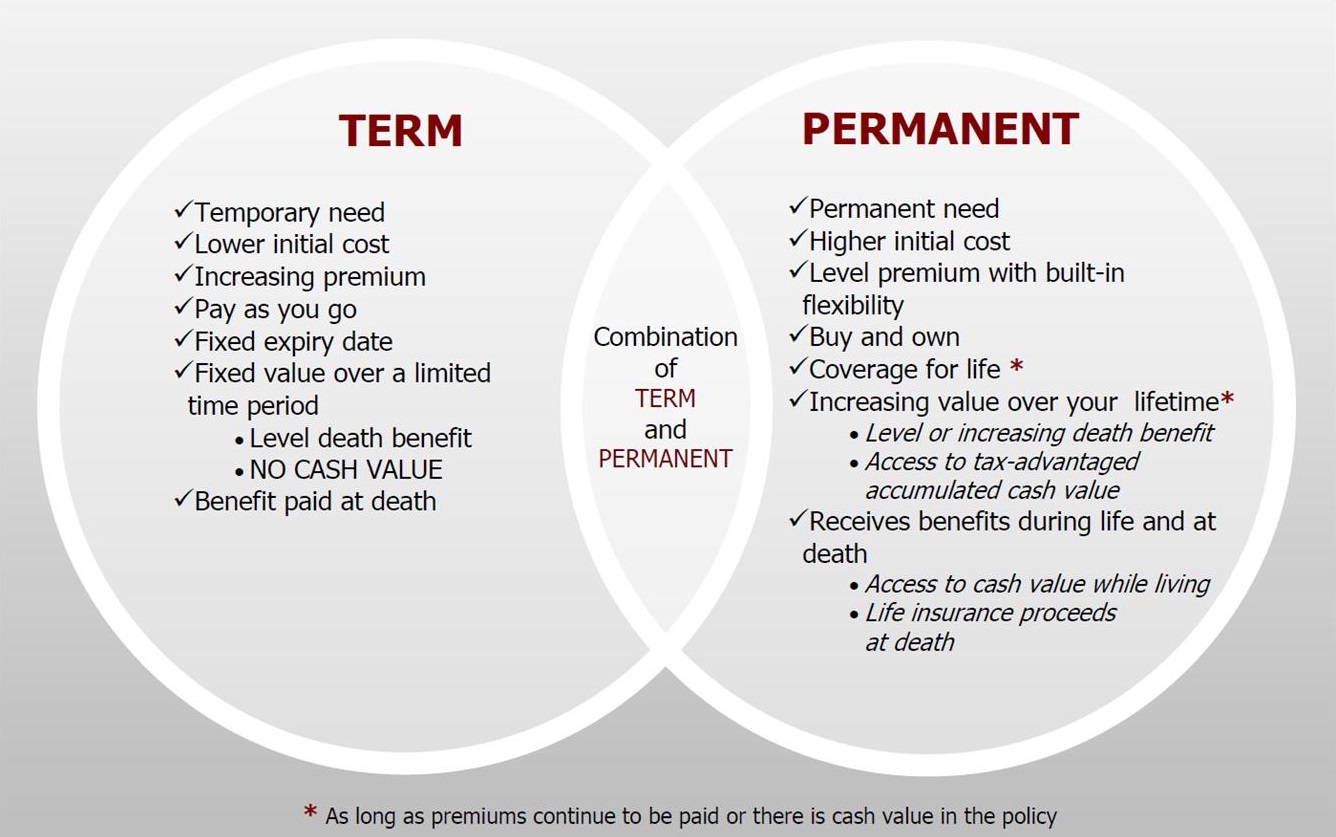
Mistake #3 – Only considering term life insurance

Term life insurance provides a “death” or “survivor” benefit, which is the amount beneficiaries receive if you pass away, for a certain period of time (15, 20 or 30 years are common increments), after which the coverage ends. An alternative solution would be to adopt cash value life insurance, which similarly provides a death benefit, but will grow over the years as long as you continue to fund the policy. Furthermore, cash value life insurance can help with financial obligations in a tax-advantaged way, whether it is paying for college, a business venture or retirement. These policies are generally more expensive, but can make a lot of sense if you are able to commit to regularly funding the policy.


Concern

Mistake #4 – Leaving retirement savings vulnerable

If you do not have any/enough life insurance, your family is likely to look to your retirement savings for financial support. This may seem like a safe solution for finding additional resources, but I would advise against using funds saved specifically for retirement for another purpose. If you are the higher earner in the family, your spouse may have been relying on those savings for his or her own retirement. Similarly, if your spouse is forced to liquidate or take large loans from the retirement account, it will hurt the potential long-term investment gains that would have benefitted your family down the road. It is important that the money you are saving is allotted for different goals – from life insurance to retirement – so that you are making the most of each savings opportunity.


Life-insurance-blog-post-150915

Mistake #5 – Guessing on how much life insurance you need

Many people who walk into my office have no idea how much life insurance they need. Is it five times annual salary? Ten times? Some other figure? There are many factors to take into account to figure out how much life insurance is right for you. Often this is where a financial professional can really help with the process. We can help quantify how much and what type of insurance makes the most sense for you and then help get that coverage in place. There are also many online calculators available to use as a starting point.

At the end of the day, we all just want to know that our loved ones will be taken care of after we’re gone. I have seen firsthand the peace of mind a life insurance policy can deliver. So this month, as life speeds up again, take a few minutes to pause and think about the future. Life Insurance Awareness month may only last 30 days, but a good policy will last for years to come!