Private Equity’s Greed Is Catching Up: Why Ordinary Americans Will Pay the Price

April 30, 2025 • By NKOZI KNIGHT

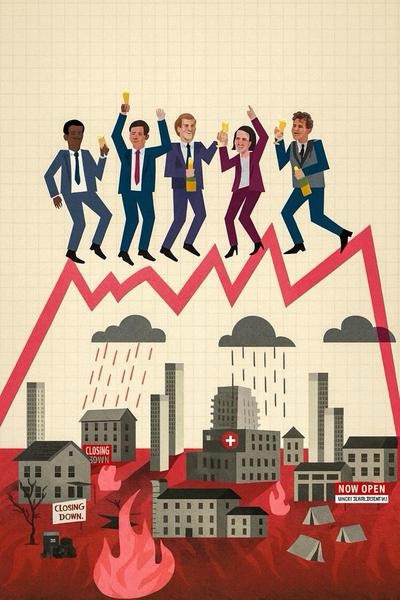
Many of us do not realize that private equity firms has always been about extraction, not creation. The model is simple. Borrow heavily, buy a company, slash jobs and benefits, sell off assets, and walk away with fees long before the damage shows. Communities are left with shuttered stores, abandoned buildings, bankrupt chains, and broken promises.

The list of casualties is long. Toys “R” Us was loaded with more than $5 billion dollars in debt by Bain Capital and KKR before it collapsed, taking 30,000 jobs with it. Payless ShoeSource closed its doors, erasing 18,000 jobs. J. Crew, Gymboree, Shopko, Forever 21, and Sears each followed the same path. Behind nearly every failure was a private equity deal that turned once-profitable companies into vehicles for debt. Blackstone, the largest of them all, drew criticism for gutting nursing homes and rental housing, where residents and tenants bore the consequences. Carlyle, Apollo, and Sycamore Partners engineered deals that enriched executives while leaving behind bankruptcies across retail, energy, and health care.

The damage has never been limited to debt. Private equity firms extract billions in fees on top of what they load onto companies. They sell the land and buildings, forcing the very businesses they own to pay rent back to them. In franchise models, they skim off royalty payments while cutting services and staff. They charge management fees to companies they already control, ensuring that even if a business fails, the firm still profits. These practices are not side effects. They are the business model.

For years the system ran on cheap money. With interest rates near zero, debt was abundant and investors were eager. Firms could buy, bleed, and flip companies in two or three years. That era is gone. Interest rates now sit above five percent. Debt costs more, buyers are scarce, and the IPO market has dried up. Firms are stuck holding companies that are drowning under the very leverage designed to enrich their owners.

The numbers are staggering. Nearly $12 trillion dollars in private equity assets now sit unsold. Exit activity has collapsed more than 70 percent since 2021. To raise cash, firms are borrowing against their own portfolios with NAV loans or dumping stakes at steep discounts on the secondary market. Even the giants like Blackstone, KKR, Apollo, Carlyle, Bain are stuck with bad debt no one wants. They cannot sell, yet their investors are demanding cash.

The quiet truth is that these firms are already maneuvering for Washington’s help. During the 2008 financial crisis, banks and insurers were rescued with taxpayer dollars. Private equity, which profited handsomely off that same collapse, is positioning itself for similar treatment.

This is not just an elite problem. It is a national one. When private equity runs out of road, it is not the billionaire partners who suffer. It is the workers whose jobs are cut, the retirees whose pensions cannot meet obligations, the students whose tuition rises because endowments cannot keep pace, and the taxpayers who are asked to backstop the system.

The parallels to 2008 are frightening. Then it was mortgage backed securities. Now it is unsellable companies and illiquid funds. In 2008, families lost homes and jobs while Wall Street was saved. Today the scale is even larger. With trillions in assets frozen, the next bailout could dwarf the last one.

Meanwhile, private equity’s destruction also extends into America’s hospitals and nursing homes and people are paying with their lives. Studies show that Medicare patients undergoing emergency surgeries in private equity–owned hospitals are 42 percent more likely to die within 30 days compared to those treated in community hospitals . A nationwide study found infections, falls, and other preventable adverse events increased following private equity takeovers of hospitals . Even the U.S. Department of Health and Human Services condemned the impact, warning that private equity ownership of nursing homes led to an 11 percent increase in patient deaths .

Recent reporting shows the financial calculus behind these tragedies. Nursing home operators in New York’s Capital Region diverted Medicare and Medicaid funds through inflated rent and bogus salaries. That left facilities chronically understaffed and suffering neglect so severe that it led to cases of serious injury and death .

By turning hospitals and nursing homes into profit centers rather than care centers, private equity firms aren’t just bankrupting businesses, they are literally killing people. And when that business model collapses, it will be everyday Americans who pay the cost once again.

The message is not subtle. If private equity’s gamble fails, the richest players will once again be saved. For ordinary Americans, the reckoning will look like it always does. Lost jobs. Higher taxes. Vanishing pensions. Rising tuition. And another generation paying for someone else’s greed.

This is the American cycle. The profits are privatized, the losses are socialized, and working families are forced to carry the cost.

Why Do Zoom Meetings Make Us So Sleepy? Unveiling the Mystery of Video Conference Fatigue

Over the past few years, the rise of remote work and the need for social distancing have transformed video conferencing tools like Zoom into a ubiquitous communication platform. While these virtual meetings have enabled people to stay connected and productive, many have also reported feeling excessively tired and sleepy after participating in them. In this article, we will explore the reasons behind this phenomenon, often referred to as ‘Zoom fatigue,’ and discuss ways to mitigate its effects.

Reduced Non-verbal Communication

One of the primary reasons for Zoom fatigue is the inherent limitations of non-verbal communication in video calls. In face-to-face interactions, we rely on a plethora of non-verbal cues, such as body language, facial expressions, and tone of voice, to fully grasp the meaning behind someone’s words. However, video calls make it challenging to perceive these cues, as participants often appear in small windows with limited visibility. This forces our brains to work harder to decipher the information, leading to cognitive overload and, ultimately, fatigue.

Constant Self-awareness

Another factor contributing to Zoom fatigue is the increased self-awareness that comes with being on camera. Many people find it difficult to ignore their own video feed, leading to a heightened sense of self-consciousness. This constant self-monitoring can be mentally draining and may cause feelings of exhaustion.

Lack of Physical Movement

During in-person meetings, participants could move around, stretch their legs, and change their posture. In contrast, video calls often require attendees to remain seated and relatively stationary in front of their screens. This lack of physical movement can lead to stiffness, discomfort, and drowsiness.

Screen Overload

In today’s digital world, many of us spend a significant portion of our day staring at screens. Adding video calls to an already screen-heavy routine can exacerbate eye strain and lead to a feeling of fatigue. Moreover, the blue light emitted by screens can disrupt our circadian rhythms, making it more difficult to fall asleep at night.

Back-to-Back Meetings

In a remote work environment, back-to-back video calls are a common occurrence. Without the natural breaks that come with in-person meetings, such as walking to a different room or engaging in casual conversation, Zoom meetings can become an unrelenting series of virtual encounters. This lack of downtime between meetings can contribute to mental exhaustion and feelings of sleepiness.

Strategies to Combat Zoom Fatigue

  1. Schedule Breaks: Allocate time for short breaks between meetings to allow your brain to rest and recharge.
  2. Encourage Movement: Stand up, stretch, or walk around during video calls to maintain energy levels and reduce stiffness.
  3. Limit Screen Time: Schedule regular screen-free periods throughout your day to reduce eye strain and fatigue.
  4. Use Audio-only Calls: When appropriate, switch to audio-only calls to give your eyes a break and reduce self-consciousness.
  5. Optimize Your Environment: Ensure your workspace is well-lit and ergonomic to minimize physical discomfort and promote alertness.

Zoom fatigue is a real and prevalent issue faced by many people participating in video conference meetings. By understanding the factors that contribute to this exhaustion, we can take steps to minimize its impact and maintain our energy levels throughout the workday.

What Emmett Till’s Mother Taught Me About Grief and Justice

On Feb. 26, 2012, my entire life changed in ways that I could never imagine. Within an instant, after the brutal and inhumane killing of my son, …

What Emmett Till’s Mother Taught Me About Grief and Justice

Five ways of expanding your business internationally

The global economy is changing thanks to worldwide connectivity. Companies across the globe are communicating with others without delays or hassles …

Five ways of expanding your business internationally

5 Tips to Get Your First Business off the Ground

Building your first business is tough. Building any business is tough, but your first is going to be especially difficult – you have no mistakes to …

5 Tips to Get Your First Business off the Ground

7 Interview Questions to Help You Assess Emotional Intelligence

“Look for a team player who brings something positive to the company”

Emotional intelligence is the ability to recognize one’s own and other people’s emotions, to discriminate between different feelings and label them appropriately, and to use emotional information to guide thinking and behavior.

5 Common Networking Mistakes You’re Making

Mixer_0By 

Building a network of people that you don’t get along with is completely pointless.

The Leadership Insider network is an online community where the most thoughtful and influential people in business contribute answers to timely questions about careers and leadership. Today’s answer to the question: What’s the best way to network? is written by Scott Kriz, CEO of Bitium.

All too often, I see people at networking events exchanging business cards and starting up superficial conversations for obviously one-sided, self-serving purposes. But what happens when you leave the happy hour or the conference? How many of those conversations resulted in something substantial? Networking should be viewed as the beginning of long-lasting, mutually beneficial relationship. While there’s no formula to creating a valuable network, there certainly are guidelines. Here are five lessons I’ve learned while building and strengthening my network:

Be authentic
When I was fresh out of college, I used to attend events and come home with a pile of business cards, trying to figure out how each person could benefit me in my career. Guess how many of those turned into valuable relationships? Not one. Realizing this, I stopped bringing cards with me to events. Instead, I started attending events with smaller groups of people and focused more on getting to really know everyone on a personal level. Over time, I found that people with whom I shared common personal interests tended to provide more value than those with closer professional ties.

See also: What a game of chess can teach you about networking

Listen and ask questions
While I love sharing stories, I have never learned anything by hearing myself talk. So I try to focus on learning from other people’s experiences by taking a genuine interest in that person and asking them questions instead. For example, a few years ago, I found out the CMO from Microsoft had retired and was living in Southern California. Marketing has always been an area that fascinated me because it didn’t come naturally. I wanted to learn about marketing from the top mind in B2B marketing software so I could better understand it for my own business.

Through my network, I found out that she was going to be at a local accelerator event so I decided to attend as well. It’s amazing how generous people are with their time and their knowledge when you express genuine interest. Mich Mathews is now an investor and board member for Bitium–and a close friend of mine.

Seek out people that you like
Building a network of people that you don’t get along with is completely pointless. Every one of us has our own opinions, tastes and tolerances. Spend your time with people you like and you will find natural alignment. When I started my current company, I was lucky enough to have a co-founder that I had enormous respect for both personally and professionally. We wanted to hire the smartest employees, of whom we also enjoyed working with. Everyone on our current team has been hired through a personal or professional connection. I’m proud of this, not only because I love what we do as a company, but because I love the people that I am building the company with.

See also: Business cards aren’t outdated and 4 other networking tips

Put yourself in someone else’s shoes
Some of the best networkers that I know are busy and overcommitted by nature. In order to leverage their networks appropriately and get the introductions I want, I’ve found that the less intrusive and more specific that I can be, the more likely they are to help out. Put yourself in the shoes of the person who is being solicited and read the content of the email as if you are that person. Make your email request is concise, specific, not completely self-serving and most importantly, easy for them to forward on to the person you want an introduction to. Help them help you.

Be yourself
Remember that everyone is just a person, no matter what they have achieved or how well-known they are. It’s easy to get star struck when meeting someone you’ve read about or who is considered a ‘celebrity’ in your industry. Approach them like you would anyone else at an event. Too many times people try to force a conversation because they really admire someone and want nothing more than to be associated with that person. Relax, have fun and don’t try to foster relationships that aren’t natural.

Read all answers to the Leadership Insider question: What’s the best way to network?

How to work a room at an important networking event by Carol Leaman, CEO of Axonify.

The one question you have to ask everyone you network withby Clark Valberg, CEO of InVision.

3 signs you’re a serial meet-and-greet networker by Shadan Deleveaux, director of sales multicultural beauty division at L’Oréal USA.

Forget what you know about networking. Do this instead by Jim Yu, CEO of BrightEdge.

3 networking mistakes you don’t know you’re making by Dan Finnigan, CEO of Jobvite.

Why face-to-face networking will never go out of style by Kevin Chou, co-founder and CEO of Kabam.

How to effectively network (even if you dread it) by David DeWolf, president and CEO of 3Pillar Global.

The only thing you need to keep in mind when networkingby William Craig, founder and president of WebpageFX.

Why social media alone won’t get you a job by Gary Vaynerchuk, co-founder and CEO of VaynerMedia.

NYSE President: I owe every job I’ve ever had to networking by Tom Farley, president of the NYSE.