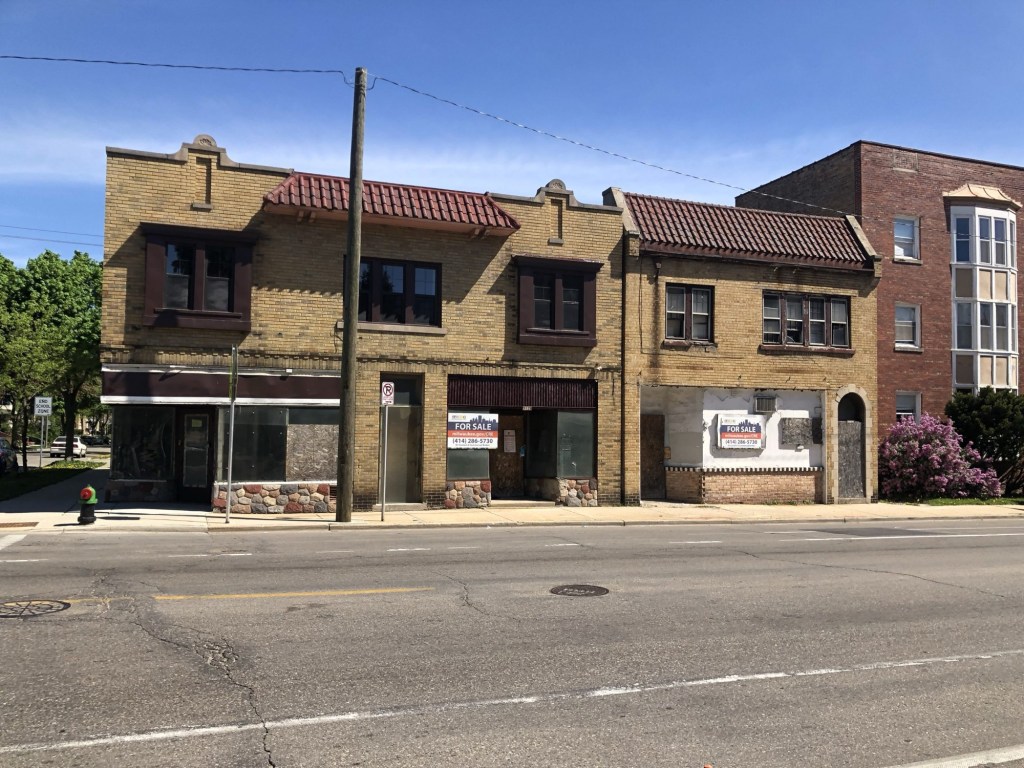
5128-5130 W. Center St. and 5124-5126 W. Center St. Photo by Jeramey Jannene.
MILWAUKEE — From 1st and Center Street west to Sherman Boulevard, abandoned buildings sit like open wounds on both sides of the street, remnants of factories, stores like Family Dollar, and once-thriving Black-owned businesses that used to anchor Milwaukee’s north side. For residents here, the phrase “America First” hits different. It’s not just a slogan. It’s a question.
What happened to America First?
When Donald J. Trump returned to the White House in January, he promised a revival of the economic nationalism that swept him into power in 2016. He talked about lifting up working-class Americans, restoring pride, and rebuilding the nation from the inside out. But early policies out of Washington tell a different story, a story where billions are sent overseas, while communities like this one are left to decay.
Foreign Priorities, Local Consequences
In the first 100 days of Trump’s second term, more than $22 billion has gone to foreign military aid, including a $3.8 billion annual commitment to Israel until 2028, and billions more to Ukraine. Meanwhile, federal programs that fund youth service, veteran reintegration, and inner-city job development are facing the axe.
The Corporation for National and Community Service , the agency behind AmeriCorps, is on the chopping block with $400 Million already cut from the budget in April. In Milwaukee, where City Year corps members help stabilize struggling schools, the impact will be immediate. “These cuts aren’t abstract,” said Vanessa Brown, a local educator and Marquette University graduate. “They take away people, resources, and hope.”
A Tale of Two Budgets
Supporters of the Trump administration say the military spending is about protecting American interests abroad. But on Milwaukee’s North Side, where gun violence, underfunded schools, and housing insecurity dominate daily life, the disconnect feels personal.
“You can walk five blocks and count ten boarded-up or burned down houses,” said Art Jones, a university professor and youth mentor. “But we’ve got money to build houses in Ukraine? Explain that to the kids sleeping in a shelter tonight.”
The Promise of Jobs, Still Waiting
Despite the tough talk on trade and manufacturing, many local plants never reopened after the last recession. Tariffs might have protected certain industries on paper, but they didn’t bring back the jobs and probably never will. What they did do, critics argue, is hike prices on everyday goods , from construction materials to car parts , squeezing small business owners and working families alike.
“It’s smoke and mirrors,” said Renee Evans, who owns a small contracting firm near Burleigh. “We were promised revitalization projects. What we got was new empty buildings and shuttered storefronts.”
The Border and the Backlash
While the administration has doubled down on mass deportations and immigration crackdowns, there’s been no meaningful investment in immigration courts or visa reform, creating longer delays and more confusion for legal immigrants, employers, and even military families. It’s a harsh policy with little planning, and local economies like Milwaukee’s which is reliant on immigrant labor in many work sectors is feeling the strain.
Is “America First” Just a Slogan Now?
For many here, the question isn’t whether America First has failed, it’s whether it was ever real to begin with. The country’s resources still seem to flow upward and outward, not inward to the communities that were promised revitalization.
“If this is America First,” said Kaleb Tatum, shaking his head outside a shuttered youth center on North Avenue, “we must not be part of America.”





 Nkozi Knight