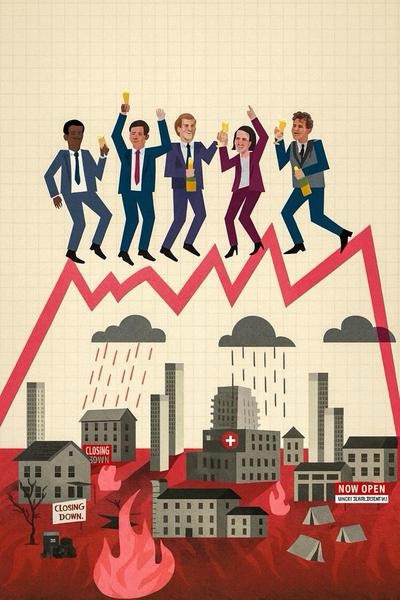
Private Equity’s Greed Is Catching Up: Why Ordinary Americans Will Pay the Price

April 30, 2025 • By NKOZI KNIGHT

Many of us do not realize that private equity firms has always been about extraction, not creation. The model is simple. Borrow heavily, buy a company, slash jobs and benefits, sell off assets, and walk away with fees long before the damage shows. Communities are left with shuttered stores, abandoned buildings, bankrupt chains, and broken promises.

The list of casualties is long. Toys “R” Us was loaded with more than $5 billion dollars in debt by Bain Capital and KKR before it collapsed, taking 30,000 jobs with it. Payless ShoeSource closed its doors, erasing 18,000 jobs. J. Crew, Gymboree, Shopko, Forever 21, and Sears each followed the same path. Behind nearly every failure was a private equity deal that turned once-profitable companies into vehicles for debt. Blackstone, the largest of them all, drew criticism for gutting nursing homes and rental housing, where residents and tenants bore the consequences. Carlyle, Apollo, and Sycamore Partners engineered deals that enriched executives while leaving behind bankruptcies across retail, energy, and health care.

The damage has never been limited to debt. Private equity firms extract billions in fees on top of what they load onto companies. They sell the land and buildings, forcing the very businesses they own to pay rent back to them. In franchise models, they skim off royalty payments while cutting services and staff. They charge management fees to companies they already control, ensuring that even if a business fails, the firm still profits. These practices are not side effects. They are the business model.

For years the system ran on cheap money. With interest rates near zero, debt was abundant and investors were eager. Firms could buy, bleed, and flip companies in two or three years. That era is gone. Interest rates now sit above five percent. Debt costs more, buyers are scarce, and the IPO market has dried up. Firms are stuck holding companies that are drowning under the very leverage designed to enrich their owners.

The numbers are staggering. Nearly $12 trillion dollars in private equity assets now sit unsold. Exit activity has collapsed more than 70 percent since 2021. To raise cash, firms are borrowing against their own portfolios with NAV loans or dumping stakes at steep discounts on the secondary market. Even the giants like Blackstone, KKR, Apollo, Carlyle, Bain are stuck with bad debt no one wants. They cannot sell, yet their investors are demanding cash.

The quiet truth is that these firms are already maneuvering for Washington’s help. During the 2008 financial crisis, banks and insurers were rescued with taxpayer dollars. Private equity, which profited handsomely off that same collapse, is positioning itself for similar treatment.

This is not just an elite problem. It is a national one. When private equity runs out of road, it is not the billionaire partners who suffer. It is the workers whose jobs are cut, the retirees whose pensions cannot meet obligations, the students whose tuition rises because endowments cannot keep pace, and the taxpayers who are asked to backstop the system.

The parallels to 2008 are frightening. Then it was mortgage backed securities. Now it is unsellable companies and illiquid funds. In 2008, families lost homes and jobs while Wall Street was saved. Today the scale is even larger. With trillions in assets frozen, the next bailout could dwarf the last one.

Meanwhile, private equity’s destruction also extends into America’s hospitals and nursing homes and people are paying with their lives. Studies show that Medicare patients undergoing emergency surgeries in private equity–owned hospitals are 42 percent more likely to die within 30 days compared to those treated in community hospitals . A nationwide study found infections, falls, and other preventable adverse events increased following private equity takeovers of hospitals . Even the U.S. Department of Health and Human Services condemned the impact, warning that private equity ownership of nursing homes led to an 11 percent increase in patient deaths .

Recent reporting shows the financial calculus behind these tragedies. Nursing home operators in New York’s Capital Region diverted Medicare and Medicaid funds through inflated rent and bogus salaries. That left facilities chronically understaffed and suffering neglect so severe that it led to cases of serious injury and death .

By turning hospitals and nursing homes into profit centers rather than care centers, private equity firms aren’t just bankrupting businesses, they are literally killing people. And when that business model collapses, it will be everyday Americans who pay the cost once again.

The message is not subtle. If private equity’s gamble fails, the richest players will once again be saved. For ordinary Americans, the reckoning will look like it always does. Lost jobs. Higher taxes. Vanishing pensions. Rising tuition. And another generation paying for someone else’s greed.

This is the American cycle. The profits are privatized, the losses are socialized, and working families are forced to carry the cost.


The Private Equity Trap: How Harvard, Yale, and Princeton Got Caught in a Liquidity Crisis

For decades, private equity was the hottest corner of finance. The model was simple. Buy a company, cut costs, load it with debt and fees, polish the books, and sell it again within two to three years for a hefty profit. It was called the “flip,” and it made fortunes for firms like Blackstone, KKR, and Carlyle. Endowments and pensions rushed to get a piece of it.

That model is now broken.

The exits that once came fast and lucrative have slowed to a crawl. A world of near-zero interest rates is gone. Debt that once financed buyouts at minimal cost now comes with punishing interest, squeezing margins and stretching holding periods. Instead of flipping companies in two years, funds are sitting on assets for six, seven, even ten years. The portfolio backlog is staggering: more than $12 trillion worth of private equity assets sit unsold worldwide.

And at the center of this crisis are the universities that built their wealth on the promise of private equity. Harvard, Yale, and Princeton reshaped modern investing by betting heavily on illiquid alternatives. They now face the consequences of that bet.

The Death of the Flip

The two-year turnaround was never sustainable, but for a time it worked. Cheap debt fueled endless rounds of leveraged buyouts, where firms borrowed heavily, stripped assets, cut staff, and pushed companies back to market at inflated valuations.

But the cycle depended on two things: cheap money and eager buyers. Both have disappeared. The Federal Reserve’s rate hikes have doubled and tripled the cost of debt financing. Buyers are cautious, corporate balance sheets are tighter, and the IPO window remains largely shut.

Exit activity tells the story. In 2021, private equity firms sold $840 billion worth of companies. By 2023, that figure had collapsed to $234 billion, a drop of 72 percent. Even with a partial rebound in 2024 to $468 billion, exits are far too low to clear the backlog. Funds are holding twice as many assets as they did in 2019, but are selling them at the same pace as five years ago.

Without exits, distributions to investors dry up. Endowments that expected cash back to fund university budgets are left waiting.

Interest Rates as the Choke Point

Private equity’s entire model is built on leverage. A firm that buys a company for $10 billion may finance $7 billion of that price with debt, leaving just $3 billion of investor equity. If interest rates are low, debt is cheap, and any improvement in the business magnifies returns.

But with rates at five percent or higher, the math no longer works. Debt service eats into earnings. Refinancing becomes expensive or impossible. Companies bought at lofty valuations in 2020 and 2021 are now struggling to cover interest costs, let alone generate attractive profits for resale.

For the funds that hold them, paper valuations remain high, but real buyers demand discounts. That gap between reported NAV and market reality is another reason sales have slowed.

The Mechanics of Desperation

To keep investors from revolting, firms have engineered liquidity out of thin air. NAV loans lines of credit secured by the assets in a fund allow managers to borrow cash and hand it back to investors as if it were a distribution. Continuation funds where a firm sells a portfolio company from one of its funds into another fund it also controls in effect creates the illusion of an exit, while extending the holding period indefinitely.

On the investor side, endowments and pensions have turned to the secondary market, selling their stakes in private equity funds to buyers willing to take them at a discount. In 2024, secondary volume hit a record $155 billion. Harvard sold $1 billion worth of fund stakes. Yale is preparing to sell as much as $6 billion. The New York City pension system sold $5 billion. Buyers snapped them up at 10 to 15 percent discounts to stated value. For venture portfolios, the discounts were as steep as 50 percent.

These maneuvers do not solve the problem. They buy time. The only true fix is exits with real sales, IPOs, or recapitalizations and the industry is years away from clearing the overhang.

Case Studies: The Ivy League Squeeze

Harvard has a $53 billion endowment, the largest in the world. Nearly 40 percent of it is tied up in private equity. In April 2025, Harvard moved to sell $1 billion of those stakes through Jefferies, while simultaneously planning to issue $750 million in bonds. The official explanation is liquidity management, not distress. But the resemblance to 2008, when Harvard was forced to borrow billions to cover private equity calls, is unmistakable.

Yale built the “Yale model,” with nearly half of its $41 billion endowment allocated to private assets. For years, this made Yale the envy of institutional investors. But in 2024, Yale returned just 5.7 percent, compared to 13.5 percent for a basic stock-bond index. Now it is exploring a $6 billion secondary sale, nearly 15 percent of its endowment. The sale is not about strategy. It is about cash.

Princeton has a smaller endowment, about $35 billion, but the same exposure. Its longtime CIO Andrew Golden called 2023 the worst liquidity environment he had ever seen. Princeton raised $1.4 billion in bonds to shore up its balance sheet. Like Harvard and Yale, it insists the strategy is intact. But the reality is that illiquidity has become a liability.

Why This Matters to Everyday Americans

It is tempting to see this as an elite problem, billion dollar universities mismanaging their fortune. But it is not.

Endowments fund scholarships, financial aid, and core research. If Harvard or Yale faces a liquidity squeeze, it means fewer students receive aid. It means tuition rises to fill the gap. It means labs lose funding and staff lose jobs. What begins as a crisis in private equity becomes a crisis for students and families.

The same holds true in pensions. State retirement systems have billions tied up in private equity. When distributions dry up, they cannot meet obligations to retirees. That shortfall has to be covered by raising taxes, cutting benefits, or, in the worst case, turning to the federal government for relief. For millions of working and middle class Americans, this is not abstract. It is their retirement on the line.

The parallels to 2008 are chilling. Then, it was mortgage backed securities that turned toxic. Homeowners defaulted, banks failed, and Washington rushed in with taxpayer bailouts. Families lost houses, jobs, and savings, while Wall Street was rescued. Today, the scale is even larger. With twelve trillion dollars in unsold assets stuck on private equity books, the next bailout could dwarf 2008.

Imagine the politics of that moment. A populist like Donald Trump could frame it as Ivy League elites and Wall Street executives begging for lifelines while ordinary Americans pay the price. But the structural interdependence is real. If endowments and pensions buckle, the pressure on Washington to intervene may be irresistible. The federal government does not have the fiscal room to absorb another trillion dollar rescue, yet that may be exactly what is asked of it.

The burden would not fall on universities or private equity firms alone. It would fall on taxpayers, on students already struggling with debt, on workers who depend on pensions, on families already squeezed by inflation and high borrowing costs. In short, it would fall on the very people who had no hand in creating the mess.

Private equity sold itself as the smartest bet of modern finance. But the two year flip is dead, interest rates have choked the model, and endowments that once trusted in illiquidity now find themselves trapped. For everyday Americans, the lesson is as clear as it was in 2008: when the smartest people in the room gamble with other people’s money and lose, it is everyone else who ends up paying the price.

Ironheart and the Betrayal of Storytelling


Riri Williams, Ironheart, stands beside her armor modeled after Iron Man, a symbol of the genius and potential that Marvel’s adaptation failed to honor.

When Marvel introduced Riri Williams in Black Panther: Wakanda Forever, she felt like a revelation. A young Black genius, bold and quick-witted, standing confidently beside Shuri and Wakanda’s leaders, she radiated promise. Audiences believed she was destined to inherit the mantle of brilliance that Tony Stark left behind.

The Disney Plus series Ironheart undid all of that. Rather than elevating Riri’s genius, the show stripped her down and leaned on clichés. Instead of building an earned character arc, Marvel forced one, and when audiences rejected it, Disney did not admit the problem was storytelling. It turned on its own fans, deflecting fair criticism as misogyny or racism. That response only deepened the sense of betrayal.

What made Ironheart sting was not representation but its absence of authentic narrative. Riri’s journey was reactive rather than inventive, her brilliance muted to the point where she seemed less capable than in Black Panther 2. Her supporting cast was too thin to provide depth, leaving Dominique Thorne to carry scenes without the balance that seasoned actors could have offered. This was the opposite of what Marvel did with Tom Holland’s Spider-Man, where young talent was elevated by veterans like Robert Downey Jr. and Michael Keaton. In Ironheart, there was no gravitas to steady her.

The most glaring missed opportunity was the arc itself. In the comics, Riri is mentored by Tony Stark’s AI, a natural continuation of Iron Man’s legacy and a relationship that challenges her intellect. That arc was abandoned in favor of an AI woman who felt more like a nagging caricature than a mentor. It was meant to look progressive, but it flattened Riri even further. Instead of sharpening her genius through real tests, the show reduced her to tropes and sidelined the one connection that could have tethered her to Marvel’s larger story.

What took its place was a parade of stereotypes. The single mother household. The absent father. The drive-by shooting that killed her stepfather. Drugs and street crime. Poverty. Black and Latino men both hyperviolent and emasculated. Struggle as the entire identity. These were not fresh interpretations of culture. They were shortcut stereotype boxes checked by writers who did not seem to understand the communities they were trying to represent.

Audiences are tired of this. They want aspiration and intelligence, not clichés. The success of Black Panther proved that. That film grossed more than $1.3 billion worldwide because it was rooted in authenticity and celebrated Black excellence. It trusted viewers to embrace complexity. Ironheart, by contrast, felt like it was written on autopilot, with representation treated as the main plot line coupled with bad writing.

The reception told the story. Ironheart failed to enter the top ten streaming shows at launch, averaging fewer than 90 million minutes per episode. Nielsen reported just 526 million minutes viewed in its debut week a fraction of Marvel’s earlier dominance. Viewers who began often did not finish. Critics offered cautious praise, but audiences were blunt. Rotten Tomatoes’ audience score fell into the mid-50s. IMDb scored it a dismal 3.7 out of 10. By every measure, this was the weakest Marvel Studios project to date.

Instead of listening, Disney dismissed its fans. Criticism was waved away as misogyny or racism. But this is dishonest. Marvel fans embraced Black Panther, Into the Spider-Verse, and Miles Morales because those stories were intelligent and authentic. They reject Ironheart because it was shallow. Viewers are not bigoted for noticing lazy storytelling. They are discerning enough to know when a studio has lost its way.

Riri Williams deserved better. She deserved a story that celebrated her genius and connected her to Iron Man’s legacy in a way that felt earned. She deserved writing that matched the promise we glimpsed in Wakanda. What we got instead was a hollow series that leaned on stereotypes, dulled its lead, and insulted its audience.

Marvel once thrived because it told stories with depth and intelligence, trusting its fans to embrace complexity. Ironheart showed what happens when that trust is broken. We are not rejecting representation. We are rejecting lazy representation. If Disney refuses to admit that the real problem is storytelling, it will not just be one show that fails. It will be the entire brand.

Disney did not fail Riri Williams. It failed to believe her brilliance was enough.

The Overseers We Never Chose: Fallout’s Lesson for America

Fallout has long had a cult following, first as a groundbreaking video game series and now as a television show that has pulled in both longtime fans and newcomers. The franchise has always thrived on its mix of retrofuturistic style and sharp social commentary, holding up a mirror to the world we live in. *Spoiler alert* for those who haven’t seen the first season of the TV series: in Vault 31, democracy is a lie. Citizens are told their votes matter, that their overseers rise from among the people, but every leader is secretly thawed from a hidden vault of corporate executives loyal only to Vault Tec. The rituals of elections and speeches reassure the vault dwellers that their voices count, while the real outcomes are already fixed. It is chilling science fiction, but the longer you study American politics since the assassination of John F. Kennedy, the harder it is to escape the feeling that Fallout wasn’t imagining the future so much as describing our present.

The reveal of Vault 31 lands because it shatters the illusion of choice. The people of Vaults 32 and 33 believed they had agency, but every overseer came from the same frozen pool, bred and trained to serve Vault Tec’s hidden agenda. Their loyalty was never to the voters. It was always to the corporation.

Since Kennedy’s death, America has lived inside its own Vault 31. Every four years the nation goes through the pageantry of elections. Presidents come and go, parties trade control of Congress, the culture wars shift. Yet the deeper structures never move. No matter who holds power, the bipartisan loyalty to Israel remains absolute. Johnson armed Israel after the Six-Day War. Nixon rushed weapons during the Yom Kippur War. Reagan and Bush tightened the security umbrella. Clinton, Bush, and Obama ensured billions kept flowing. Trump moved the U.S. embassy to Jerusalem. Biden oversees record-breaking aid while Gaza burns. The names change. The policy does not.

The numbers tell the story. According to the Council on Foreign Relations, Israel has received over 300 billion dollars in U.S. assistance since its founding. Under Obama, a 10-year agreement guaranteed 38 billion in military aid. In just one year of the 2023–2024 conflict in Gaza, U.S. spending tied to Israel’s military operations reached nearly 23 billion. This, while America itself is drowning under more than 37 trillion dollars of debt, equal to about 108,000 dollars per citizen. Israel, by contrast, carries a manageable debt-to-GDP ratio under 70 percent while providing free university education and universal healthcare. Americans are told such programs are impossible at home, yet they are funded abroad without hesitation.

The pattern extends beyond aid. U.S. wars in the Middle East consistently serve Israel’s strategic position and the corporate interests tied to the military-industrial complex. Marines bled in Beirut. Americans fought and died in Iraq, Syria, and Libya. Each war was packaged as necessary for freedom and democracy, but the freedom secured was rarely America’s. The strategic winner was Israel, and the financial winners were corporations. Lockheed Martin, Raytheon, and Northrop Grumman collected more than 770 billion dollars in Pentagon contracts between 2020 and 2024, more than double what the U.S. spent on diplomacy and humanitarian aid in the same period. The “forever wars” were not fought for working-class families in Detroit or Milwaukee. They were fought to guarantee regional dominance and to feed the balance sheets of private contractors. Fallout’s Vault Tec experimented on people under the pretense of protection. Our reality is a government that funnels tax dollars into endless conflict while calling it security.

And through all of this, Israel has not looked like the shining democracy Americans are taught to revere. For nearly two decades Benjamin Netanyahu has dominated Israeli politics, surviving corruption charges and coalition collapses while reshaping the judiciary to protect his grip on power. This permanence resembles the overseers of Vault 31, thawed again and again no matter what turmoil erupts on the surface. Yet American leaders, Democrat and Republican alike, continue to describe Israel as “the only democracy in the Middle East,” a line repeated so often it becomes dogma.

The most disturbing part is not simply the loyalty to Israel but the bipartisan nature of it. Americans fight bitterly over abortion, guns, climate policy, and healthcare. But on Israel there is no debate. Nearly unanimous votes in Congress approve billions in aid even as American bridges collapse and millions remain uninsured. Like the citizens of Vault 32 and 33, Americans are given the ceremony of choice, but not the power to alter outcomes.

This is where Fallout’s metaphor becomes unavoidable. Vault 31 is not just a story about post-apocalyptic survival. It is about how democracy is hollowed out when leaders are preselected by hidden powers. Elections become performance. Ritual replaces substance. The real loyalty of overseers is not to the people but to those who control the system behind the curtain. In Fallout that power is Vault Tec. In our world it is the combined force of entrenched political lobbies, military corporations, and a bipartisan consensus that places Israel’s security above America’s domestic needs.

For over sixty years, Americans have gone through the motions of democracy while watching the same outcomes repeat. Debt climbs. Wars expand. Corporations profit. Israel thrives. The names on the ballots change, but the overseers do not.

When future generations look back, they will not remember the campaign slogans. They will not remember the televised debates. They will ask who saw through the theater. Fallout gives us the metaphor, history gives us the receipts. And unless we confront the overseers we never chose, we will go on mistaking ceremony for freedom while someone else writes the script.

Gaza is a mass casualty event.

Palestinians check the destroyed Al Jazeera tent at Al-Shifa Hospital in Gaza City on Monday, following an overnight strike by the Israeli military.Bashar Taleb / AFP via Getty Images

Aug. 11, 2025, 9:03 PM EDT

By Nkozi Knight

The argument over Gaza too often collapses into labels and talking points. That framing lets us dodge the only question that matters. Are we willing to watch human beings be starved, shot at while seeking food, and buried under rubble, and do nothing?

As of August 2025, more than 61,000 Palestinians have been killed in Gaza since October 2023, according to figures collated by the U.N. from Gaza’s Health Ministry. Over 60,199 of those deaths have been fully identified by name and demographic details. Children are roughly one third of the dead. These are conservative counts and do not capture those still under collapsed buildings or the deaths from disease and hunger.    

The health system is hardly a system anymore. The World Health Organization reports that at least 94 percent of Gaza’s hospitals have been damaged or destroyed. Many operate only in fragments, without reliable power, oxygen, or surgical capacity.   

Schools have been leveled on a historic scale. U.N. satellite assessments show about 95 percent of school buildings damaged, with hundreds directly hit. The educational future of an entire generation is in jeopardy.    

Hunger is now policy by other means. The global famine monitor (IPC) warns that the food-consumption threshold for famine has already been passed in most areas of Gaza, with malnutrition and deaths rising. UNICEF has documented a sharp increase in children dying of starvation and related disease. The U.N. continues to report paltry aid flows compared with need.    

It is not just the volume of aid. It is the violence around it. After Israel dismantled the U.N.-led distribution system and backed a new contractor model this spring, multiple investigations documented civilians being shot at or killed around food sites and convoys. Hundreds have died seeking flour or canned food. These incidents are contested by Israeli authorities, but the pattern is now documented by journalists, doctors, and rights groups.   

Claims that “Hamas steals all the aid” are often made to justify these restrictions. Yet a recent U.S. government review found no evidence of massive theft of U.S.-funded aid by Hamas, even as diversion risks exist in any war. Meanwhile, Israeli far-right activists and settlers have repeatedly blocked, vandalized, or looted Gaza-bound convoys. Both truths can be held at once. Aid must be protected from diversion, and people must be allowed to eat.     

Christians are part of this story too. A Greek Orthodox church sheltering families was struck in October 2023, killing civilians. In December 2023, two Christian women were shot and killed inside the Holy Family Catholic parish compound, according to the Latin Patriarchate and the Vatican. The small Christian community has continued to suffer deaths and deprivation through 2024 and 2025.     

Here is the moral core you asked to preserve:

This is not about being anti-Semitic.

It is not about being pro-Hamas.

It is not even about taking a side on Israel’s right to be in the Middle East.

It is about being human.

It is about the countless lives lost.

The countless lives destroyed.

The generations of families wiped from the earth.

It is about the deliberate starvation of people who are already trapped in devastation.

International law is not silent about any of this. The Genocide Convention defines genocide as specific acts committed with intent to destroy a protected group. Those acts include killing, causing serious bodily or mental harm, and inflicting conditions of life calculated to bring about a group’s physical destruction. You do not need to be a lawyer to understand what “conditions of life” means when aid is throttled and families are shot at while queueing for food.   

Courts have acted, even if governments have not. In January and again in May 2024, the International Court of Justice ordered Israel to prevent genocidal acts and to ensure unimpeded humanitarian access, including ordering a halt to the offensive in Rafah. In November 2024, ICC judges issued arrest warrants for Israel’s prime minister and former defense minister on charges that include using starvation as a method of warfare. In July 2025, the ICC rejected Israel’s bid to withdraw those warrants.     

What should follow is not more argument. It is practical action.

Open the crossings wide and keep them open under neutral monitoring. Protect aid corridors and reinstate U.N.-led distribution at scale. Stop firing near food lines. Restore funding to agencies that have the reach to keep children alive. Enforce the ICJ’s orders. Respect the ICC process. None of this precludes holding Hamas accountable for the atrocities of October 7 or for any diversion of aid. It simply refuses to make civilians pay the price for crimes they did not commit.  

History records the numbers. Conscience remembers the names. Gaza is not a referendum on anyone’s identity. It is a of our own.