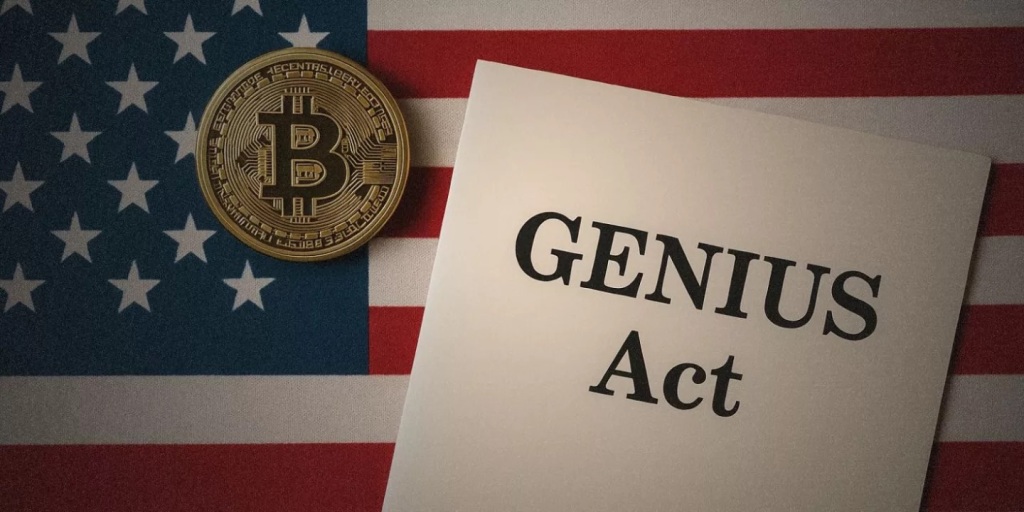
Behind Washington’s Latest Bipartisan Marvel: The Quiet Power Grab in the GENIUS Act

Date: Wisconsin, June 28, 2025

When the Senate voted 68-30 last week to pass the Guiding and Establishing National Innovation for U.S. Stablecoins Act, or better known as the GENIUS Act, the moment barely registered in a news cycle crowded with updates from the Diddy trial, ominous talk of World War III, and who does and does have have nuclear warheads a in the Middle East. Yet the bill is poised to reshape American money itself, setting the stage for bank-issued digital dollars and a vastly expanded federal role in everyday payments that will impact every Americans for the next decade.

House leaders now plan to bundle the measure with a separate market-structure bill, the CLARITY Act, and move both to the floor in a single vote as early as the week of July 7. President Trump has already signaled he will sign the package “without delay.”  

A $265 Million Campaign Pays Off

Passage caps the costliest crypto lobbying blitz on record. Industry groups and super PACs spent more than $265 million during the 2024 election cycle, which is nearly double the previous year, to elect crypto-friendly candidates and draft the very language that now governs them.  

Much of that money flowed through Fairshake, a super PAC bankrolled by Coinbase, Ripple and venture fund a16z, which alone poured over $130 million into congressional races. Thirty-three of its thirty-five endorsed candidates won which ties them with AIPAC.

The bill’s corporate sponsors read like a who’s-who of finance:

JPMorgan Chase filed a trademark for JPMD, a deposit-backed token it can now launch on Coinbase’s Base network.   PayPal and several regional banks lobbied for an exemption that lets them issue “payment stablecoins” under state charters.   World Liberty Financial, the Trump-family venture behind the USD1 stablecoin, secured a new $100 million investment from a UAE fund days before the vote.  

What the Bill Actually Does

This bill re-labels stablecoins as “payment systems,” taking them out of securities law and handing primary oversight to the Fed and the Office of the Comptroller of the Currency, creating an aura of legitimacy. It also creates a licensing moat: only banks and “permitted issuers” that meet 1-to-1 reserve, audit and AML rules can mint tokens—locking smaller DeFi projects outside the gate. Mandates monthly disclosures of reserves but allows issuers to hold short-term Treasuries, providing fresh demand for federal debt.   Bars members of Congress and their immediate families from trading stablecoins—but notably leaves the White House exempt. Senator Elizabeth Warren called this “a loophole big enough to drive a truck full of crypto through.”

The Bipartisan Pattern: Crypto and Foreign Wars

The only other legislation that has moved this smoothly across party lines in recent years is foreign-aid spending for Ukraine and Israel. In April 2024 Congress passed a $95 billion package for Ukraine, Israel and Taiwan with overwhelming majorities in both chambers, with all packages hovering over $300 billion in the last 5 years.

Critics argue the same donor class such as defense contractors abroad and crypto financiers at home, dictates both agendas. “If it involves new weapons or new money rails, Congress finds consensus,” says Sarah Bryer, a former Senate banking staffer now at watchdog group Public Citizen. “Everything else stalls.”

What Gets Missed While Washington Innovates

Poverty: The Supplemental Poverty Measure rose to 12.9 percent in 2023, the first increase in a decade.   Homelessness: More than 770,000 Americans were unhoused on a single night in January 2024, the highest count ever recorded.   Disaster Recovery: Communities from Maui to East Palestine still wait on promised federal funds years after their crises. To date the U.S. Congress has held nine hearings but passed no comprehensive relief bills for any of these victims.

Yet lawmakers devoted 18 months of hearings and four mark-ups to ensure banks can mint digital dollars.

A New Architecture for Control

Civil-liberties attorneys warn that putting money on permissioned blockchains invites mission creep. Once every transaction is traceable:

Payments can be geofenced or frozen at the click of a regulator’s dashboard. Political dissenters can be de-banked without ever seeing a courtroom. Cash’s untraceable refuge disappears, replaced by tokens that obey code written in Washington and often debugged on Wall Street.

Senator Warren, one of just eleven Democrats opposed, likened the bill to the 2000 Commodities Futures Modernization Act, which green-lit credit-default swaps before the 2008 crash. “We’re repeating history,” she warned on the floor. 

What Happens Next

If the House delivers the bill to President Trump before the July 4 recess, bank-branded stablecoins could hit the market within a year. JPMorgan’s JPMD pilot is ready; PayPal has quietly updated code to let its wallet swap into compliant tokens.

For ordinary Americans, the promise is faster payments, at least until the rules change. “Digital dollars are programmable,” notes Bryer. “Today they clear instantly. Tomorrow they refuse to buy a bus ticket to the wrong protest.”

The Bottom Line

The GENIUS Act is not just a regulatory tweak; it is the blueprint for a cashless, centrally mediated economy shaped by the largest banks, the loudest lobbyists and a White House with skin in the game. That it passed under the radar says as much about the media distractions of the moment as it does about the power of money in Washington.

As many households grapple with rising rents, increased living expenses, stubborn poverty and record homelessness, Congress has found rare harmony over who controls the future of money itself. When the dust settles, Americans may discover their new digital wallet comes with fewer rights than the battered leather one it replaced.

While You’re Watching Game 7 of the NBA Finals, We’re Being Sold Out Piece by Piece

We’re not watching a dramatic fall of America. There are no breaking news alerts about the end. No explosions in the streets. No economic sirens.

But make no mistake….something terrible is happening.

Piece by piece, decision by decision, we are being sold out. Our labor, our taxes, our future, it is all being extracted. And while it happens, we are told to look the other way while letting AI take many of our jobs.

Watch the game. Scroll the feed. Place a bet. Argue online about culture wars that do not affect your rent, your hospital bill, or your ability to afford groceries.

Meanwhile, the money keeps flowing. Out of your paycheck. Out of your neighborhood. Out of this country. Straight into the hands of foreign governments, defense contractors, and elite interests.

This is not the dramatic fall of a nation. It is a transfer of wealth, security, and stability away from ordinary Americans and toward a system that was never built to serve us. It is a system that acts globally, extracts locally, and survives only as long as we do not look directly at it.

You can call it a government. You can call it a machine. But what it really functions as is an empire. And the longer we ignore it, the more it takes.

The Cost of That Empire Is Being Paid in Evictions and Empty Refrigerators

While your tax dollars are used to fund missile systems in Israel, people across the United States are struggling just to keep a roof over their heads. Since 2020, the median price of a home has risen by more than 40 percent. Interest rates have climbed above 7 percent, making homeownership unreachable for millions (National Association of Realtors, 2024).

At the same time, Americans like myself, carry over $1.7 trillion in student loan debt. Medical bankruptcies remain the most common form of personal financial ruin. A premature baby that has to stay in a neonatal intensive care unit for over a month can cost well over a million dollars. On top of that, more than half of the country cannot afford an unexpected five hundred dollar emergency.

And yet, every year, tens of billions of dollars are approved for foreign aid without hesitation.

Israel receives more U.S. taxpayer money than any other nation on Earth. Since 1948, it has received over 300 billion dollars in aid, including nearly 4 billion annually in guaranteed military funding (Congressional Research Service, 2023).

That money has helped fund a public healthcare system, subsidized childcare, and modern infrastructure. Israel’s students have new schools. Their citizens have access to doctors without going bankrupt.

Meanwhile, in American cities, teachers work second jobs. Classrooms go without books. People drive across state lines to afford prescriptions. And in cities like Flint, Michigan and Jackson, Mississippi, families still live without safe drinking water.

This is not about scarcity. It is about priorities.

An Economy Built to Keep Us Consuming

We are told that the economy is doing well. But it only looks strong on paper because we are constantly spending to survive.

Wages have remained flat for decades, while the cost of everything else has gone up. Food, gas, housing, tuition, and insurance have all exploded. But instead of fixing the system, the solution we are offered is more debt.

Buy now, pay later.

Zero percent financing.

Monthly subscriptions for everything, even the essentials.

Our economy runs on credit cards and desperation.

We are not building wealth. We are surviving one paycheck at a time, and no one is willing to admit it.

And when that stress becomes too much, we are handed another solution, a distraction. Sometimes it’s a RICO case of a famous celebrity, other times it’s the United States bombing an empty nuclear facility in Iran, and other times it’s something as simple as sports and sports betting.

There is always something to pull our focus. Sports betting is now a multi-billion dollar industry thanks to ESPN, Draft Kings, Prize Picks, and MGM Sports betting. On television, sex-laden reality shows dominate prime time and paid subscriptions. Viral celebrity drama trends daily. Meanwhile, airstrikes in Gaza or explosions in Tehran are buried beneath all this noise but we pay for all of it.

None of this is random. It is a carefully designed system.

We Fund a Better Life for Others While We Are Told to Settle for Less

The average American is constantly being told to sacrifice.

Tighten your belt.

Use credit.

Be patient.

Inflation is temporary.

Work harder.

But there is no austerity when it comes to military aid.

There is always money for war. There is always money for foreign governments. There is always money to rebuild somewhere else in a land most have never been, but there is nothing for Maui, East Palestine, Flint, New Orleans, and many other cities in America.

Since 1948, Israel has received over 300 billion dollars in U.S. assistance (Reuters, 2024). That money has helped create one of the best publicly funded healthcare and education systems in the world—for a country with fewer people than New York City.

In America, we have veterans sleeping on the street in every major city.

We have kids learning from worksheets because their school cannot afford books.

We have families rationing insulin and choosing between medication and rent.

This is not just a funding issue. It is a values issue.

We are paying for the stability of others while our own communities are crumbling.

They Keep Us Distracted So We Do Not See It

Every time the conversation gets too close to real issues, the distractions flood in.

The headlines suddenly shift, and Operation Mockingbird goes full tilt. The scandals erupt more salacious than the prior one. The outrage machine gets turns on, and Americans are pinned against each other.

We are told to obsess over celebrities, argue over culture wars, and follow political soap operas like they are sports teams.

This is not a coincidence. It is the only way this corrupt system survives.

Because if we stop fighting each other, we might start asking the real questions.

Where is the money going?

Why can’t we afford basic services while funding foreign militaries?

Why is our economy built on debt and distraction?

And who exactly is benefiting from all of this since it’s not US?

This Is Not Incompetence. It Is a Strategy.

The truth is that the United States has all the resources it needs to take care of its people….if it wanted to.

But we do not. Not because we can’t. But because we are not supposed to.

We are expected to work, consume, and remain distracted.

We are expected to stay tired, stay anxious, and stay divided.

And we are expected to believe that any attempt to change the system is unrealistic, unpatriotic, or impossible.

But the truth is, the system is not broken. It is functioning exactly as designed.

It is designed to take.

It is designed to distract.

And it is designed to leave us wondering why we are doing everything right and still falling behind.

Can You Relate

If you are working harder than ever but getting nowhere, you are not alone.

If you are wondering why another country has healthcare and you cannot afford a routine checkup, you are asking the right question.

If you are tired of being told that sacrifice is patriotic while billionaires and foreign allies get blank checks, then maybe it is time we stop playing along.

They do not fear Iran. They do not fear China. They do not fear Russia.

What they fear is that you will start paying attention.

Because the moment we stop watching the show and start watching the system, the game is over.

Sources

National Association of Realtors. (2024). Median home price trends

Congressional Research Service. (2023). U.S. Foreign Aid to Israel

Reuters. (2024). Israel aid totals and annual packages

CNBC. (2023). 80 percent of Americans live paycheck to paycheck

Cato Institute. (2021). U.S. Military Footprint: 750 bases in 80 countries

Al Jazeera. (2021). U.S. global base presence overview

This Was Never About Democracy


Joint Chiefs Chairman Gen. Dan Caine speaks during a news conference at the Pentagon in Washington on Sunday, June 22, 2025, following U.S. airstrikes on three sites in Iran. The strikes mark the first direct American military involvement in support of Israel’s effort to dismantle Iran. (AP Photo/Alex Brandon)

By a Former SFO

On June 22, 2025, the United States launched Operation Midnight Hammer, a precision airstrike that hit three of Iran’s most fortified nuclear sites. The Pentagon claimed it wasn’t about regime change. But if you’ve been paying attention or like myself, you’ve worn the uniform and carried out the missions, you know that’s not true.

To the people of the world watching this unfold, wondering how we got here again, let me say what many in Washington won’t: This was never about democracy. It never is.

I’ve served in these wars. I’ve seen the playbook up close. And behind every “freedom mission,” there’s always a pipeline, a port, or a profit margin.

In Iraq, we were told we were bringing liberation. But we were guarding oil infrastructure while the country collapsed around us. Iraq has the fifth-largest oil reserves on Earth. Libya, before we shattered it, had Africa’s largest. Syria resists U.S. control and sits on key energy corridors. Yemen’s coast controls one of the most strategic oil shipping lanes in the world, known as the Bab al-Mandab Strait.

These aren’t wars for freedom. These are wars for access and control.

And it all ties back to the petrodollar. The U.S. dollar isn’t backed by gold, it’s backed by the global oil trade. When leaders challenge that system, they get taken out. Saddam Hussein tried to sell oil in euros. Gaddafi pushed for a gold-backed African currency. Both were removed, their countries reduced to chaos. Now Iran, Russia, and the expanded BRICS alliance are making the same moves trying to exit the dollar system. So now Iran is being bombed under the guise of “security.”

Let’s call this what it is: empire maintenance.

Destabilizing nations isn’t a failure, it’s the primary objective. Break countries that resist. Keep them weak. Prevent alliances with Russia, China, or anyone else outside the U.S. sphere. It’s an old playbook. Divide, conquer, install puppets. If that doesn’t work, create chaos and pretend we’re the firefighters, not the arsonists.

And don’t forget the profit. Every bomb dropped, every drone launched, every military base built feeds the defense industry. Raytheon, Lockheed Martin, Boeing, these are just a few of the real winners of every war we provoke. I saw it firsthand. I watched billion-dollar contracts handed out while our equipment in the field broke down or was left. This isn’t about patriotism. It’s a business. And business is booming no matter who the president of the United States is.

That’s why the war never ends. Permanent conflict justifies mass surveillance, not just on them but on us. It keeps over 800 U.S. military bases running. It feeds a trillion-dollar defense budget. And it keeps the American people afraid and numb, just afraid enough to keep asking for more bombs, more boots, more lies.

Now, Israel has struck first. The U.S. followed. And the war machine rolls on now pointed squarely at Iran.

This didn’t start yesterday. Back in 2007, General Wesley Clark said the Pentagon had a classified plan to take out seven countries in five years: Iraq, Syria, Lebanon, Libya, Somalia, Sudan, and Iran. Every name on that list has since been destabilized, overthrown, or bombed. Iran was the last one.

And if you’re wondering who’s next, just look at who’s resisting the dollar, blocking Western influence, or nationalizing their resources. Venezuela has already been targeted. Somalia, Niger, and others are in the crosshairs and not because they’re threats to peace, but because they’re threats to profit.

The cost? It’s not counted in defense budgets or quarterly earnings. It’s measured in bodies. In families torn apart. In children growing up under drones and rubble. In the rise of terrorist groups born out of the vacuums we leave behind. In entire generations who now associate “democracy” not with hope, but with fire raining from the sky.

“They hate us for our freedoms” was never true. They hate what we do. They hate what we destroy.

I believed the mission once. But now I see what it really was.

Regime change was never about freedom. It was always about control. About money. About fear.

And until we admit that the wars will never stop.

One System, Two Americas: R. Kelly, Mike Jeffries, Sean Combs, Jeffrey Epstein and the Color of Justice in Crime Prosecutions

The media obsession with the unfolding case against Sean “Diddy” Combs is impossible to ignore. It’s everywhere, Tik Tok, Instagram, Facebook, CNN, Fox, basically on every timeline, blog, and broadcast. The headlines are loud, the speculation endless, and the commentary often more about celebrity scandal than justice. As this spectacle plays out in public view, I found myself revisiting the 2021 federal conviction of R. Kelly, and with it, a disturbing pattern in how America chooses who to punish, and how severely.

R. Kelly was convicted under the RICO Act and sentenced to 30 years in prison, eerily similar to what Sean Combs is being charged with. A year after R Kelly first conviction, another federal case was added to that sentence, bringing his total to 31 years behind bars. The charges included racketeering, sex trafficking, and child pornography. The government argued that he led a criminal enterprise, supported by staff and enablers who helped him recruit and control young victims, despite being the only one charged. The use of RICO, a law designed to dismantle organized crime syndicates like the mob, was a bold move, typically reserved for drug kingpins, gang leaders, or mob bosses. In Kelly’s case, it somehow worked. The full weight of the system came down on him.

Now compare that to the cases of Mike Jeffries, Jeffrey Epstein, and Ghislaine Maxwell.

Mike Jeffries, the former CEO of Abercrombie & Fitch, was publicly accused in 2023 of running an elaborate international sex trafficking operation targeting young men from multiple countries. Dozens of young men who were children at the time of the assaults, came forward to describe a system involving international travel, handlers, coercion, NDAs, and systematic abuse. The allegations sound terribly worse than the criminal enterprise described in R. Kelly’s case. Yet Jeffries has not been charged, arrested, or even publicly booked. No mugshots. No indictment. No RICO charges. No salacious articles. No seizure of properties. Nothing. 

Then there’s Jeffrey Epstein and Ghislaine Maxwell. Their operation was also international, and larger, and longer, and involved far more victims than Robert Kelly’s. Epstein ran a global sex trafficking network that serviced elite figures across politics, business, and even royalty, yes no one has been charged despite the world knowing the names. Our current administration even ran on releasing the names and all the documents and as of June 2025, we have nothing. These young underage girls were flown across borders. Some ended up permanently silenced, some threatened, and some ignored entirely. And still, neither Epstein nor Maxwell was ever charged under RICO. Maxwell was sentenced to just 20 years in prison. No broader conspiracy was prosecuted. No clients were named. No victims were allowed to name their abusers. No systemic breakdown occurred in court. The people who funded it, covered for it, and participated in it remain untouched.

So we’re left with a question no one in power wants to answer.

Why is RICO reserved for Black men like Robert Kelly and Sean Combs, and not white billionaires like Jeffrey Epstein or Mike Jeffries? Why does the justice system move swiftly against Black celebrities, while it drags its feet or completely ignores the same crimes committed by wealthy white elites?

Hopefully people understand that this is not about defending Robert Kelly or Sean Combs for what they are accused of and in Kelly’s case charged with. All victims deserve justice. But if justice is truly blind, then it should swing as hard with RICO charges at those who look like Jeffries, Epstein, and Maxwell. Instead, we see a two-tiered system, where race predominantly, along with status, and power determine who faces the full might of the federal government, and who gets protected by the silence of that very same government.