The Sovereign Debt Crisis is no longer a future problem, it’s a now problem

By Nkozi Knight

The most important economic story in America is not the stock market.

It is not Bitcoin.

It is not artificial intelligence.

It is not even inflation.

It is debt.

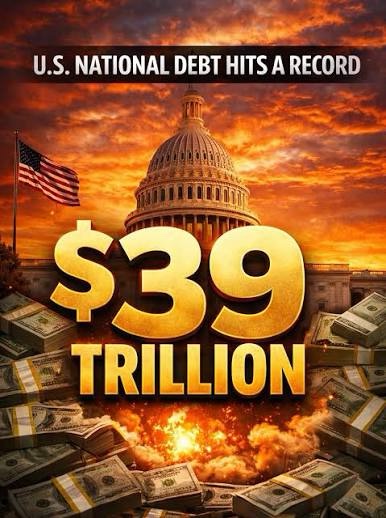
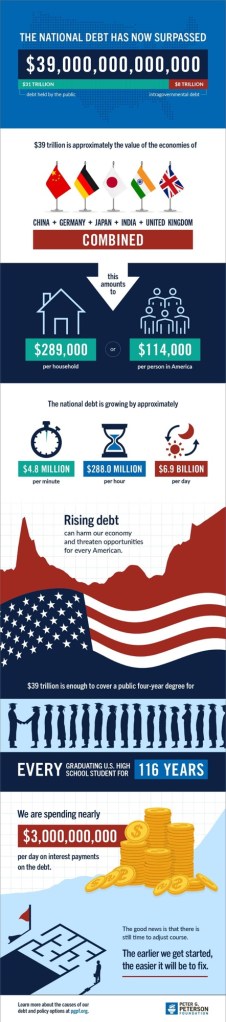
More specifically, it is what happens when the world’s largest economy accumulates nearly $39 trillion in debt while simultaneously asking investors to continue financing deficits approaching $2 trillion a year.

That number is so large it becomes difficult to comprehend.

Broken down across the population, America’s debt burden now exceeds roughly $114,000 for every person in the country.

A family of four is effectively carrying more than $450,000 of federal debt.
No, the government is not sending anyone a bill.

But that does not mean the debt disappears.

Someone always pays.

The question is how.

For decades, the answer was simple.

The United States occupied a unique position in the global economy. The dollar served as the world’s reserve currency, global commerce flowed through dollar-based financial systems, and foreign governments accumulated Treasury securities as reserves.

America benefited enormously from this arrangement.

We could borrow more, spend more, run larger deficits, and face fewer consequences than any other nation in history.

The system worked because the rest of the world trusted American debt.

Today that trust is beginning to show signs of strain.

The warning signs are not coming from politicians.

They are coming from the bond market.

The yield on the 30-year Treasury bond has climbed to around 5 percent, levels not seen consistently since before the financial crisis.

That number matters far more than most people realize.

A Treasury yield is not simply an interest rate.

It is a measure of confidence.

When investors believe the future is stable, they accept lower returns.

When risks increase, they demand higher compensation.

A 5% 30-year Treasury bond is the market’s way of saying the old assumptions are no longer enough.

And the timing could not be worse.

The federal government is projected to spend approximately $1 trillion this year just servicing existing debt.

$1 TRILLION dollars spent not on defense, infrastructure, education, veterans, or health care, but on interest.

Nothing productive is created.

The money simply services obligations accumulated in previous years.

As debt grows, those interest costs grow with it.

And because much of America’s debt was issued when rates were near zero, older bonds must eventually be refinanced at today’s much higher rates.

The result is simple math.

More debt.

Higher rates.

Higher interest costs.

Even more debt.

That is how debt spirals begin.

The international picture makes the situation even more concerning.

For decades, countries such as Japan and China helped finance America’s borrowing because Treasury bonds were considered safe, liquid, and reliable.

But that equation is changing.

Japan’s own debt exceeds twice the size of its economy, and rising domestic yields now give investors meaningful returns at home. China has also been reducing Treasury holdings while diversifying trade and reserve assets.

Neither country is abandoning the United States.

That misses the point.

The issue is marginal demand.

When the largest buyers purchase less, somebody else must step in.

To attract those buyers, yields must rise.

Higher yields mean higher borrowing costs that eventually flow through the entire economy.

Mortgage rates rise.

Auto loans rise.

Credit card rates rise.

Business financing becomes more expensive.

Commercial real estate becomes harder to refinance.

Economic growth slows.

At the same time, inflation remains stubbornly elevated.

Energy prices have surged.

Producer prices continue moving higher.

Supply chains remain vulnerable to geopolitical shocks.

Because energy sits at the center of transportation, manufacturing, and logistics, higher fuel costs ripple through the entire economy.

Consumers experience this reality every day.

Groceries cost more.

Insurance costs more.

Travel costs more.

Housing costs more.

The official inflation number may be one statistic, but the lived experience often feels much higher.

This is where the debt story and inflation story merge.

The government has very few attractive options.

It can cut spending.

It can raise taxes.

It can accept slower growth.

Or it can continue borrowing and creating additional liquidity.

Historically, heavily indebted governments tend to choose the path that appears least painful in the short term.

More borrowing.

More debt issuance.

More intervention.

More money creation.

The danger is not an immediate collapse.

That is what many people get wrong.

The United States is not likely to wake up one morning and discover that Treasury bonds are worthless or that the dollar has suddenly disappeared.

Financial systems rarely fail that way.

Confidence erodes gradually.

Then suddenly.

The greater risk is a slow deterioration in purchasing power, combined with rising interest costs and weakening demand for American debt.

The petrodollar system is not disappearing tomorrow, but it is facing challenges that would have been unthinkable twenty years ago. More nations are settling trade in alternative currencies. Regional trading blocs are reducing dependence on the dollar. Central banks are diversifying reserves.

The dollar remains dominant.

But dominance is not permanence.

And that distinction matters.

Because America’s extraordinary borrowing power has always depended on extraordinary global demand for dollars and Treasury securities.

If that demand weakens, even modestly, the math changes.

And once the math changes, the bond market notices.

The bond market is noticing now.

The question is whether Washington is paying attention.

Because at some point debt stops being a political issue.

It becomes an arithmetic problem.

And arithmetic does not care about ideology, campaign promises, or election cycles.

Eventually, the numbers win.

The Quiet Economic Crisis: America is Sliding Toward Stagflation

By Nkozi Knight

The American economy is entering its most dangerous phase since the financial crisis of 2008.

Not because of a market crash.

Not because of a banking collapse.

But because the forces that produce stagflation are quietly aligning once again.

Oil prices have surged to nearly one hundred dollars per barrel as tensions in the Middle East threaten one of the most important energy corridors in the world. At the same time job growth has stalled, inflation remains stubbornly above the Federal Reserve’s target, and American households are carrying record levels of debt. CNBC recently reported that economists are increasingly worried the United States could face a renewed stagflation threat reminiscent of the economic shocks that gripped the country in the 1970s.

For many Americans the warning signs are already visible.

Gasoline prices doubling overnight. Grocery bills being placed on credit cards. Credit card balances exceeding 10% of monthly income. Car repossession rates at record highs. These are not isolated economic signals. They are symptoms of a deeper tension within the economy itself.

Stagflation is one of the most difficult economic conditions a country can face. It combines two forces that normally do not appear together. Prices continue to rise while economic growth slows. Workers struggle to find better opportunities while the cost of living keeps climbing. Governments and central banks are forced into painful choices because the policies that solve one problem often make the other worse.

The current economic environment is beginning to reflect that dangerous balance.

Energy markets sit at the center of the risk. Oil is not just another commodity. It is the foundation of transportation, agriculture, manufacturing and global trade. When oil prices rise, the effects cascade through the entire economy. Shipping becomes more expensive. Airlines raise ticket prices. Food costs increase as fertilizer and transportation become more costly. Nearly every sector eventually absorbs some portion of the shock.

The recent surge toward $100 oil was driven largely by geopolitical tension in the Middle East. According to CNBC reporting, disruptions in energy supply routes and fears surrounding the Strait of Hormuz have rattled markets and raised concerns that the price spike could persist. Even a temporary surge in oil prices can have significant ripple effects. A prolonged increase can become a full-scale economic shock.

At the same time the labor market is beginning to show signs of fatigue.

The U.S. economy lost 92,000 jobs in February while unemployment ticked upward to 4.4%. Job growth throughout the past year has slowed considerably compared with the stronger recovery period that followed the pandemic. Hiring has weakened while layoffs remain relatively limited, creating a labor market that appears frozen rather than collapsing.

This type of stagnation is precisely the environment that allows inflationary pressures to linger.

Core inflation remains near three percent, well above the Federal Reserve’s two percent target. While inflation has cooled from the extreme levels seen earlier in the decade, the reality for most households is that prices have not returned to previous levels. Instead, the cost of living has permanently reset higher.

Housing, insurance, healthcare and food continue to place increasing pressure on household budgets.

Consumer debt levels reveal how families are coping with that pressure. Americans now carry more than seventeen trillion dollars in total consumer debt. Credit card balances alone exceed one trillion dollars. As interest rates remain elevated, the cost of servicing that debt continues to rise.

This creates a dangerous feedback loop. When prices remain high and wages struggle to keep pace, households often rely on credit to maintain their standard of living. But higher borrowing costs make that strategy increasingly unsustainable over time.

The Federal Reserve now faces the same policy dilemma that defined the stagflation era decades ago.

Lowering interest rates could stimulate economic activity and ease borrowing costs for households and businesses. However, such a move risks fueling inflation at a moment when energy prices are already rising. Keeping rates high may help restrain inflation, but it could also slow hiring and investment further.

Economists often describe stagflation as the worst possible economic environment for central banks because every policy choice carries serious tradeoffs.

Financial markets are already adjusting their expectations. Investors had previously anticipated multiple interest rate cuts this year as growth slowed. The recent oil shock has complicated that outlook. Markets now expect the Federal Reserve to delay easing policy as officials assess whether inflation could accelerate again.

The situation places policymakers in an increasingly narrow corridor.

Too much stimulus risks reigniting inflation. Too little support risks pushing the economy into a deeper slowdown.

History offers a cautionary lesson. During the 1970s the United States endured years of persistent inflation combined with weak growth and rising unemployment. Oil shocks, global instability and loose fiscal policy combined to create a prolonged period of economic frustration. Wages lagged behind prices while economic confidence eroded.

Today the circumstances are different, but the pressures share familiar characteristics.

Large government deficits continue to expand the national debt. Geopolitical tensions threaten energy markets. Households rely increasingly on debt as living costs rise. Central banks attempt to balance inflation control with economic stability.

None of these forces alone guarantees stagflation. Together they create the conditions in which it becomes possible.

The greatest risk may not be an immediate economic collapse. Instead, the danger lies in a prolonged period of slow growth combined with persistent inflation. In such an environment economic progress becomes harder to achieve while financial pressure quietly builds across society.

For ordinary Americans the effects would not appear first in financial headlines.

They would appear in everyday life.

Rising car repossessions.
Higher fuel costs.
More expensive groceries.
Rising interest payments.
Rising foreclosures.
Rising evictions.
Slower wage growth.

These pressures accumulate gradually until households begin to feel that the economy itself is becoming more difficult to navigate.

The coming months will determine whether the current warning signs fade or intensify. If geopolitical tensions ease and energy markets stabilize, the economy may continue its uneven but resilient expansion. If oil prices remain elevated and growth continues to slow, the United States could find itself confronting the most complicated economic challenge of the modern era.

Stagflation rarely arrives with dramatic warning signs.

It emerges quietly, through the slow alignment of forces that gradually reshape the economic landscape.

Many economists now believe that alignment may already be underway.

Reference

Cox, J. (2026, March 9). Fears of 1970s-style stagflation arise with oil spike to $100. How big a threat is it? CNBC. https://www.cnbc.com/2026/03/09/fears-of-1970s-style-stagflation-arise-with-oil-spike-to-100-how-big-a-threat-is-it.html

Wiseman, P., & D’Innocenzio, A. (2026, March 10). U.S. lost 92,000 jobs in February as unemployment rises to 4.4%. Associated Press.
https://apnews.com/article/jobs-unemployment-economy-inflation-trump-tariffs-075a0d33e0794b7c93b9b8a7302dab98