7 Interview Questions to Help You Assess Emotional Intelligence

“Look for a team player who brings something positive to the company”

Emotional intelligence is the ability to recognize one’s own and other people’s emotions, to discriminate between different feelings and label them appropriately, and to use emotional information to guide thinking and behavior.

5 Common Networking Mistakes You’re Making

Mixer_0By 

Building a network of people that you don’t get along with is completely pointless.

The Leadership Insider network is an online community where the most thoughtful and influential people in business contribute answers to timely questions about careers and leadership. Today’s answer to the question: What’s the best way to network? is written by Scott Kriz, CEO of Bitium.

All too often, I see people at networking events exchanging business cards and starting up superficial conversations for obviously one-sided, self-serving purposes. But what happens when you leave the happy hour or the conference? How many of those conversations resulted in something substantial? Networking should be viewed as the beginning of long-lasting, mutually beneficial relationship. While there’s no formula to creating a valuable network, there certainly are guidelines. Here are five lessons I’ve learned while building and strengthening my network:

Be authentic
When I was fresh out of college, I used to attend events and come home with a pile of business cards, trying to figure out how each person could benefit me in my career. Guess how many of those turned into valuable relationships? Not one. Realizing this, I stopped bringing cards with me to events. Instead, I started attending events with smaller groups of people and focused more on getting to really know everyone on a personal level. Over time, I found that people with whom I shared common personal interests tended to provide more value than those with closer professional ties.

See also: What a game of chess can teach you about networking

Listen and ask questions
While I love sharing stories, I have never learned anything by hearing myself talk. So I try to focus on learning from other people’s experiences by taking a genuine interest in that person and asking them questions instead. For example, a few years ago, I found out the CMO from Microsoft had retired and was living in Southern California. Marketing has always been an area that fascinated me because it didn’t come naturally. I wanted to learn about marketing from the top mind in B2B marketing software so I could better understand it for my own business.

Through my network, I found out that she was going to be at a local accelerator event so I decided to attend as well. It’s amazing how generous people are with their time and their knowledge when you express genuine interest. Mich Mathews is now an investor and board member for Bitium–and a close friend of mine.

Seek out people that you like
Building a network of people that you don’t get along with is completely pointless. Every one of us has our own opinions, tastes and tolerances. Spend your time with people you like and you will find natural alignment. When I started my current company, I was lucky enough to have a co-founder that I had enormous respect for both personally and professionally. We wanted to hire the smartest employees, of whom we also enjoyed working with. Everyone on our current team has been hired through a personal or professional connection. I’m proud of this, not only because I love what we do as a company, but because I love the people that I am building the company with.

See also: Business cards aren’t outdated and 4 other networking tips

Put yourself in someone else’s shoes
Some of the best networkers that I know are busy and overcommitted by nature. In order to leverage their networks appropriately and get the introductions I want, I’ve found that the less intrusive and more specific that I can be, the more likely they are to help out. Put yourself in the shoes of the person who is being solicited and read the content of the email as if you are that person. Make your email request is concise, specific, not completely self-serving and most importantly, easy for them to forward on to the person you want an introduction to. Help them help you.

Be yourself
Remember that everyone is just a person, no matter what they have achieved or how well-known they are. It’s easy to get star struck when meeting someone you’ve read about or who is considered a ‘celebrity’ in your industry. Approach them like you would anyone else at an event. Too many times people try to force a conversation because they really admire someone and want nothing more than to be associated with that person. Relax, have fun and don’t try to foster relationships that aren’t natural.

Read all answers to the Leadership Insider question: What’s the best way to network?

How to work a room at an important networking event by Carol Leaman, CEO of Axonify.

The one question you have to ask everyone you network withby Clark Valberg, CEO of InVision.

3 signs you’re a serial meet-and-greet networker by Shadan Deleveaux, director of sales multicultural beauty division at L’Oréal USA.

Forget what you know about networking. Do this instead by Jim Yu, CEO of BrightEdge.

3 networking mistakes you don’t know you’re making by Dan Finnigan, CEO of Jobvite.

Why face-to-face networking will never go out of style by Kevin Chou, co-founder and CEO of Kabam.

How to effectively network (even if you dread it) by David DeWolf, president and CEO of 3Pillar Global.

The only thing you need to keep in mind when networkingby William Craig, founder and president of WebpageFX.

Why social media alone won’t get you a job by Gary Vaynerchuk, co-founder and CEO of VaynerMedia.

NYSE President: I owe every job I’ve ever had to networking by Tom Farley, president of the NYSE.

4 Valuable Leadership Lessons You Can Learn From the Transformers

Transformers-3-Dark-of-the-Moon-Optimus-Prime-crop_1302889481

By Minda Zetlin of Inc.

Can toys and cartoon characters really make you a better leader? Surprisingly, the answer is yes.

That’s the word from Seth M. Spain, assistant professor of organizational behavior at Binghamton University. He and his colleague Peter Harms have turned their analytic skills on the Transformers, the popular Japanese-American toys, comic books, animation, and movie characters that can turn themselves from robots into vehicles and other types of machines. Spain and Harms found that the lessons in their character descriptions are full of wisdom about what makes a great leader.

Why study the Transformers in the first place? For one thing, Spain explains, each toy comes with both a rank and a rating of the character’s abilities, which makes it easier to compare them to each other. Also, “Peter knew I was a general-purpose mid-30s nerd and the Transformers would be something I’d be interested in.”

The two put together a database of each Transformer characters using the toys’ rankings and “my painfully extensive knowledge of the cartoon series,” Spain says. They published their findings in a Psychology Today blog post titled “What Would Optimus Prime Do?” In it, they make the argument that emulating the leader of the Autobots (the good Transformers) really can improve your leadership skills.

“What was most surprising—given this is a toy and cartoon series for fairly small children—was how representative the findings were of what we know about leadership from regular academic study,” Spain says. Here’s a look at some of the wisdom you can glean from the Transformers:

1. Don’t Have Too Many Bosses

Leaderless, flat, and more democratic organization structures are getting lots of attention these days—mostly because they work surprisingly well and sometimes outpace the competition. That’s because removing management layers and the high salaries that go with them allows such companies to run leaner and more efficiently.

Same goes for Transformers. “The Autobots have a flatter, less hierarchical, more equal organization,” Spain says. “Whereas the Decepticons (evil Transformers) are more vertical, with a despot ruling by fiat.”

2. Be Very Smart

“The most important quality for Transformer leaders is intelligence,” Spain says. “We looked at good guys and bad guys separately and the best predictor of rank was a high rating in intelligence.”

That mirrors the real world. “The academic literature says that intellectual ability is a predictor of both leader emergence and leader effectiveness,” Spain notes. “We’re not necessarily talking book smarts or academic achievement,” he adds. “It could be what used to be called a shrewd business sense. There’s a certain swiftness of mind.”

3. Know Who You’re Leading

“One of the main things we did was look at followership in the cartoon show,” Spain says. “We broke it down into examples of both constructive and destructive followers. The Decepticons have really good examples of both excellent and really bad followers.”

One outstanding example of a really bad follower is Starscream, a lieutenant in the Decepticons. “He’s constantly plotting to overthrow the leader Megatron, but Megatron keeps him around for some reason, even though he often tells him he’s not smart enough to be a leader.” That strategy backfires in an early animated episode when the Decepticons are about to defeat the Autobots until Starscream mucks things up with an assassination attempt against Megatron.

“On the other hand, Megatron has other followers who are extremely loyal and dependable,” Spain notes. “One lesson from that is to be aware of your followers and what they’re all about.” That may be difficult for a leader such as Megatron, he adds. “Classic Dark Triad leader may not be paying a lot of attention to their followers and may miss a lot of information,” he says. “But even evil leaders need good followers if they’re going to succeed.” (Here’s more on the Dark Triad and how a small dose of evil qualities can benefit every leader.)

4. Care About Everyone

Caring for others may be the most important attribute that sets Optimus Prime apart from Megatron. “Optimus Prime is constantly trying to make sure his followers are OK, and that human beings aren’t harmed in the fights between robots,” Spain notes. Compassion and integrity are vital traits for a leader, he adds.

That’s really the central message of this research. “The sociological point we’re trying to make is that narratives of all kinds can communicate norms and expectations about leadership,” Spain says. “So holding up a popular example can be very useful.”

In other words, try asking yourself “What would Optimus Prime do?” It really can lead you to the best decision.

About The Author

Inc.com is where you can find everything you need to know to start and grow your business now. Inc.com is replete with small business ideas, information, and inspiration, as well as practical advice from those who have done it before.

Wisconsin Colleges and Universities by Cost in 2015

Below is a chart of Wisconsin colleges and universities from lowest to highest tuition cost.

Institution Name City In-State Cost Net Cost Website
Chippewa Valley Technical College Eau Claire $3,395 $8,555 Go
Madison Area Technical College Madison $3,666 $12,576 Go
Mid-State Technical College Wisconsin Rapids $3,666 $8,614 Go
Milwaukee Area Technical College Milwaukee $3,666 $9,071 Go
Blackhawk Technical College Janesville $3,666 $9,193 Go
Waukesha County Technical College Pewaukee $3,666 $9,122 Go
Moraine Park Technical College Fond du Lac $3,666 $9,617 Go
Western Technical College La Crosse $3,666 $8,802 Go
Northcentral Technical College Wausau $3,666 $9,188 Go
Fox Valley Technical College Appleton $3,666 $6,969 Go
Northeast Wisconsin Technical College Green Bay $3,666 $8,892 Go
Gateway Technical College Kenosha $3,666 $7,637 Go
Lakeshore Technical College Cleveland $3,666 $7,261 Go
Southwest Wisconsin Technical College Fennimore $3,667 $7,590 Go
Wisconsin Indianhead Technical College Shell Lake $3,910 $8,567 Go
Nicolet Area Technical College Rhinelander $4,039 $6,487 Go
Lac Courte Oreilles Ojibwa Community College Hayward $4,560 $6,609 Go
University of Wisconsin Colleges Madison $4,750 $8,410 Go
College of Menominee Nation Keshena $6,000 N/A Go
University of Wisconsin-Stevens Point Stevens Point $6,298 $11,820 Go
University of Wisconsin-Green Bay Green Bay $6,298 $11,557 Go
University of Wisconsin-Parkside Kenosha $6,298 $9,348 Go
University of Wisconsin-Platteville Platteville $6,418 $12,952 Go
University of Wisconsin-Oshkosh Oshkosh $6,422 $11,703 Go
University of Wisconsin-River Falls River Falls $6,428 $12,014 Go
           
Institution Name City In-State Cost Net Cost Website
University of Wisconsin-Whitewater Whitewater $6,519 $11,332 Go
University of Wisconsin-Superior Superior $6,535 $11,565 Go
University of Wisconsin-Stout Menomonie $7,014 $14,264 Go
University of Wisconsin-Eau Claire Eau Claire $7,361 $12,940 Go
University of Wisconsin-La Crosse La Crosse $7,585 $12,927 Go
University of Wisconsin-Milwaukee Milwaukee $8,091 $14,882 Go
University of Wisconsin-Madison Madison $9,273 $16,536 Go
University of Phoenix-Milwaukee Campus Milwaukee $10,560 N/A Go
Rasmussen College-Wisconsin Green Bay $10,764 N/A Go
Herzing University-Kenosha Kenosha $11,150 N/A Go
Herzing University-Brookfield Brookfield $11,150 N/A Go
Herzing University-Madison Madison $11,150 N/A Go
Maranatha Baptist University Watertown $11,980 N/A Go
Northland International University Dunbar $12,290 N/A Go
Anthem College-Brookfield Brookfield $13,806 N/A Go
Globe University-Madison East Madison $14,040 N/A Go
Globe University–Green Bay Green Bay $14,040 N/A Go
Globe University–Madison West Middleton $14,040 N/A Go
Globe University–Wausau Rothschild $14,040 N/A Go
Globe University-La Crosse Onalaska $14,040 N/A Go
Globe University-Appleton Grand Chute $14,040 N/A Go
Globe University-Eau Claire Eau Claire $14,040 N/A Go
The Art Institute of Wisconsin Milwaukee $14,868 N/A Go
Strayer University-Wisconsin Milwaukee $15,300 N/A Go
DeVry University-Wisconsin Milwaukee $15,930 N/A Go
Madison Media Institute Madison $16,309 N/A Go
Bryant & Stratton College-Milwaukee Milwaukee $16,530 N/A Go
Bryant & Stratton College-Wauwatosa Wauwatosa $16,530 N/A Go
Bryant & Stratton College-Bayshore Glendale $16,530 N/A Go
Bellin College Green Bay $20,000 N/A Go
Lakeland College Plymouth $21,960 N/A Go
Alverno College Milwaukee $22,656 N/A Go
Viterbo University La Crosse $22,740 N/A Go
Silver Lake College of the Holy Family Manitowoc $22,950 N/A Go
Marian University Fond Du Lac $24,300 N/A Go
Mount Mary University Milwaukee $24,598 N/A Go
Wisconsin Lutheran College Milwaukee $24,620 N/A Go
Edgewood College Madison $24,666 N/A Go
Cardinal Stritch University Milwaukee $24,800 N/A Go
Concordia University-Wisconsin Mequon $24,930 N/A Go
Carroll University Waukesha $27,039 N/A Go
Northland College Ashland $29,000 N/A Go
Milwaukee Institute of Art & Design Milwaukee $29,474 N/A Go
Saint Norbert College De Pere $31,266 N/A Go
Ripon College Ripon $31,329 N/A Go
Milwaukee School of Engineering Milwaukee $32,880 N/A Go
Marquette University Milwaukee $34,200 N/A Go
Carthage College Kenosha $34,850 N/A Go
Lawrence University Appleton $40,926 N/A Go
Beloit College Beloit $40,970 N/A Go

2015 University Rankings- Wisconsin

11 Top-Ranked Wisconsin Colleges and Universities

Top Ranked Universities in Wisconsin- Highest Overall School Score

5 Steps For Building Trust And Credibility

In today’s hyper-connected and transparent marketplace, brands and products arrive and depart at hypersonic speeds.

According to the 2012 Edelman Trust Barometer, For the first time, trust and transparency are just as important to a company’s reputation as the quality of their products and services. In U.S.A., these two elements stand even higher than product quality.

Cautious of fraud, scams, and scheming marketing tactics, customers are beginning to perceive the world defined by genuine or contrived. More often than not, they’re basing their buying decisions on how authentic they judge an offer to be.
AAEAAQAAAAAAAAMCAAAAJDIzNWU4OGMxLWY4YTgtNDUxYi1iZjY4LWRmZDk2ODIzZjU5MA

Unfortunately though, many companies don’t practice trustworthiness and credibility. Alternatively, they attempt to grow their firms based what they believe customers want to hear.

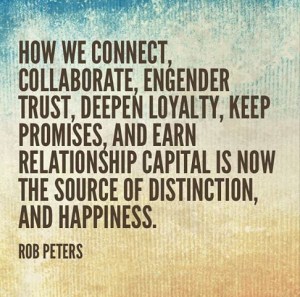
But listening to prospects and customers and mindlessly responding back what they state isn’t going to earn trust or relationship capital from the customer. It is not about deceiving people with amazing commitments. Rather, it is about courageously proclaiming what you believe, and then withdrawing to observe who is attracted to your idea.

Credible brands are able to earn a loyal following; a social community, so to speak. Happy customers will share their experiences with peers and friends, and if the company stays true to its messaging and continues to deliver products and/or service that are in alignment with the customers’ hopes, it will be on the path toward building a relationship capital brand built for the long-run.

If you’re thinking of elevating your organizational culture, launching a startup or developing a brand, think of the 4 attributes of earning Relationship Capital (RC):

•Character
•Competence
•Good Intent
•Proactivity

Take the Free Relationship Capital (RC) Test. I welcome you to take this assessment in confidence as we never share this information outside Standard of Trust.

 5 Steps For Building Trust And Credibility

The following steps are by no means the only ways to build trust, credibility, and relationship capital, but they are the most important.

1. Define Your Purpose and Guiding Principles

The first step is to determine what your credibility is composed of. You will need to choose which guiding principles you are willing to commit to no matter what. If you commit to the open standard principles of Relationship Capital (RC), they are the following:
•Honesty
•Accountability
•Responsibility
•Support
•Respect
•Trustworthiness
•Emotional Boundaries

AAEAAQAAAAAAAALZAAAAJGZiMTc4NWFmLWFiZTEtNDI2ZS1iYzc2LWI0ZWU5NDMwZDczNg

Your ability to embed this relationship capital guiding principles into your company’s purpose will be an effective way in earning and building relationship capital with your stakeholders that will sustain long-term distinction.

For example, the Purpose of the Standard of Trust Group is:

To make a difference to business organizations and their stakeholder relationships through the capture, measurement, and utilization of open standards of relationship capital. To assist business leaders and their organizations to compete by out-behaving the competition.

horiz-warning-banner

Let me “Warn” you. Do not make superficial commitments to the relationship capital guiding principles or other principles you may select. Inauthentic behavior will be found out by the social and digitally connected tribe and your reputation and credibility will be damaged

2. Determine How You Will Demonstrate Authenticity

Look for the moments to demonstrate your authenticity. Whether it’s online with social media or your LinkedIn blog, or in offline interactions with others, take the time to learn and understand your audience and permit to learn and understand you too.

3. Be Open

How far would you go to show your authenticity and credibility? Decide how you will demonstrate your guiding principles and how open you want to be. Then make a plan of action for showcasing this openness.

4. Be Consistent

Keep your communications consistent. The messages that you’re sending out through marketing, promotions and social media should be in alignment with the offline experience that you provide to customers.

5. Prepare For Resistance

Finally, get ready for the resistance. When you build a certain level of awareness, you’re going to get people who oppose. Don’t let this dishearten you or sidetrack you from your guiding principles and purpose. Stay committed to your principles, and you will earn respect (and relationship capital) from the people around you. Your loyal and customers, employees, partners, and brand ambassadors will defend and support you.

Conclusion

Whether a business leader, entrepreneur or startup, committing your authentic self is about being true to your guiding principles and fulfilling your stated commitments to your stakeholders (customers, employees, or partners).

Leading with authenticity is not for everyone, but those who decide to utilize this as the foundation for establishing or nurturing a relationship capital business or a relationship capital brand will learn that building a company based on purpose, performance, and relationship capital will provide sustainability despite the accelerating changes that may come in the future.

By Robert Peters

Sources: Standard of Trust: Leadership