Beneath the Clothes We Donate: How America’s Fast Fashion Addiction is lDrowning Ghana

By Nkozi Knight


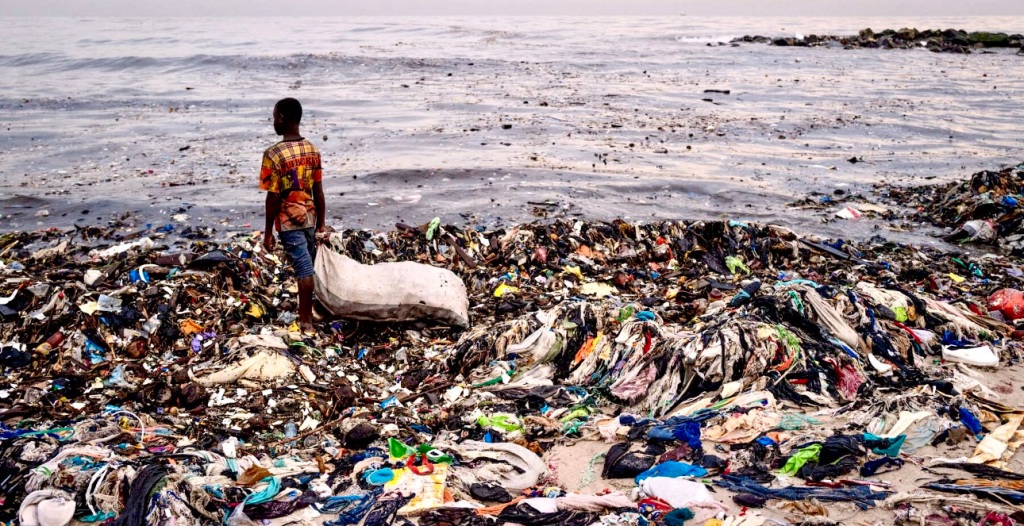
A young boy stands amid mountains of discarded clothing and plastic waste on Ghana’s Chorkor Beach

Accra, Ghana

The beaches of Ghana should be sanctuaries. Places where waves kiss the sand and children play in peace. But on the shores of Chorkor Beach, the tide doesn’t bring seashells. It brings sweaters from Shein, leggings from Lululemon, and Target tees soaked in salt and filth.

Week after week, a deluge of secondhand clothing arrives in Ghana from the United States, the United Kingdom, and other industrialized nations. Billed as “donations,” these shipments are not gifts. They are refuse. They are the castoffs of a culture addicted to overconsumption and numbed to consequence.

Ghana receives roughly 15 million garments a week, much of it dumped by consumers who believe they’re “doing good” by donating to local bins outside of Walmart or church parking lots. In reality, 40 percent of these clothes are unusable trash, exported to West Africa in bulk and eventually dumped, burned, or strewn across the coastline. Kantamanto Market in Accra, once a center of textile trade and reuse, has become overwhelmed and swamped by low-quality fast fashion designed to fall apart before its first wash.

“We are drowning in your clothing,” said a local vendor in a recent BBC Africa Eye documentary. “These aren’t donations. They are poison.”

This isn’t hyperbole. Synthetic fabrics, often polyester, don’t biodegrade. They clog drains, suffocate marine life, and release microplastics into the ecosystem. Some are so contaminated with dyes and industrial chemicals that simply burning them chokes nearby residents. Because Western brands outsource both the problem and the blame, few Americans ever witness the wreckage.

The Cult of the New

American corporations drive this destruction through a business model of planned obsolescence and psychological manipulation. Fast fashion giants like Shein, Fashion Nova, Boohoo, and H&M churn out hundreds of new styles weekly. And we buy them. On impulse. To feel something. To impress no one. To post once on social media and then forget.

A 2023 Vogue Business investigation reported that the average American throws away 81 pounds of clothing per year. That’s nearly 13 billion pounds of textile waste, most of which is either burned or exported. Out of sight. Out of mind.

The 2024 HBO documentary Brandy Hellville and the Cult of Fast Fashion peeled back the curtain on this global racket, revealing how corporations knowingly flood developing nations with clothing that cannot be sold, recycled, or reused. These companies profit from both ends of the pipeline, selling cheap clothes and then writing off their “donations” for tax breaks.

But in Ghana, the beaches tell the truth. Children walk barefoot through piles of wet fabric. Fishermen cast their nets into waters tangled with discarded bras and sweaters. Clothes meant for dignity now strip the land of its own.

Stop Pretending It’s Helping

The problem is systemic, but it starts at home.

Donating clothes in bins is not inherently virtuous. In fact, it’s part of the illusion. The vast majority of those clothes don’t go to shelters or local families. They are sold in bulk to global brokers who profit off Africa’s environmental misery.

We are not helping. We are offloading guilt.

The solution cannot be just more donation or wishful recycling. It begins with consuming less. Buy intentionally. Wear things longer. Mend. Repurpose. Swap. Or better yet, just don’t buy unless you need to. The world doesn’t need another $9 tee you’ll forget in a week.

And for the clothes that have truly reached their end? Perhaps it’s time to explore municipal incineration, compostable textiles, or clothing deposit programs where manufacturers are held financially responsible for their waste. We regulate plastic straws more than we regulate stores like Forever 21, H&M, and Walmart.

A Final Reckoning

Americans, if we do not change, beaches like Chorkor will disappear, buried under the weight of our vanity and excess. What once were coastal communities tied to fishing, family, and resilience are now becoming textile graveyards. The soil is dying. The water is choking. The air burns with the fumes of our unwanted clothes that takes 200 years to naturally decompose.

This is no longer just about fashion. It’s about justice.

Because let’s be honest: we know who’s responsible.

The responsible parties include: Shein, H&M, Zara, Forever 21, Fashion Nova, Boohoo, PrettyLittleThing, Temu, Target, Walmart, Old Navy, Uniqlo, Gap, Amazon’s in-house brands, and countless Instagram and Tik Tok shops. These corporations flood the global market with billions of garments each year. Their business model thrives on overproduction, cheap labor, and psychological manipulation. They manufacture the illusion of need. They sell you a fantasy of trendiness and self-expression at the cost of someone else’s environment and dignity.

And we, the consumers, buy in. Often literally.

Every impulse buy, every “haul” video, every $5 tee or $10 dress contributes to a planetary cycle of destruction. We wear it once, toss it in a bin, and tell ourselves we did something good by “donating.” But we’re not recycling. We’re relocating the problem. Our discarded clothes are not going to those in need. They’re going to countries like Ghana, Kenya, Chile, and Haiti, nations without the infrastructure to process the sheer volume of waste we produce.

Because the truth is: your closet might be clean, but someone else is paying the price for it.

And they’re paying with their soil, their seas, and their breath.

We need a global reckoning. Not just with corporations, but with ourselves.

Buy less. Buy better. Demand accountability. Push for laws that make brands responsible for the full life cycle of their products.

Until we stop treating clothing as disposable, we will continue to treat people the same way.
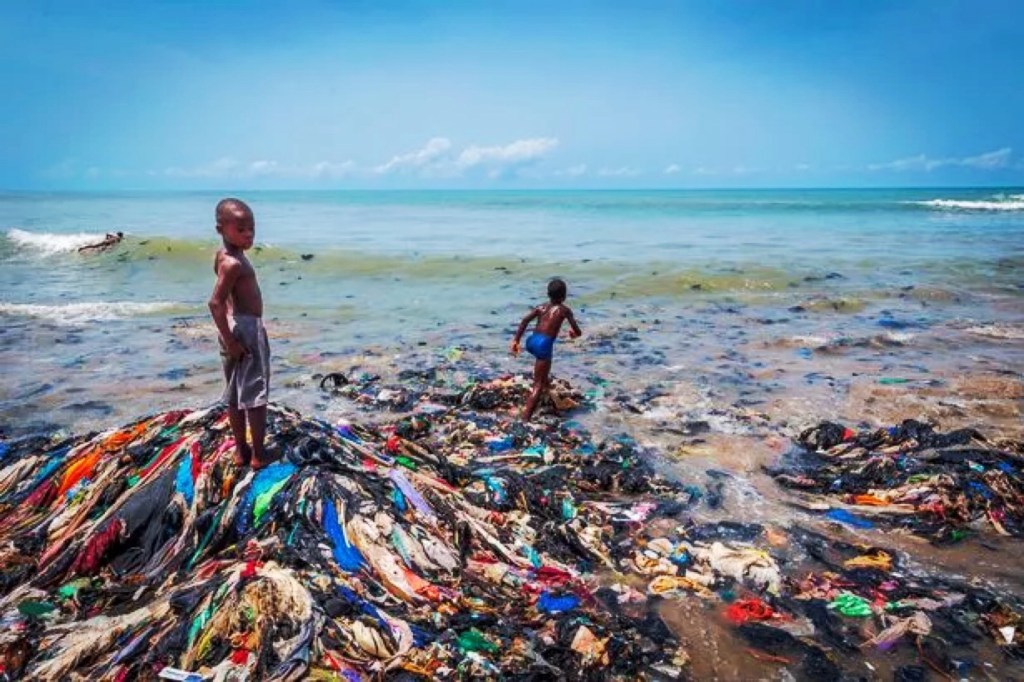
Boys play in the sea diving off a pile of clothing found washed up on the beach at Jamestown, Accra(Image: Adam Gerrard / Daily Mirror

For a video documentary, watch:

Ghana: Fast fashion dumping dumping ground

Further Reading and Resources:

Greenpeace Report: Fast Fashion, Slow Poison

HBO Documentary: Brandy Hellville & The Cult of Fast Fashion

AP News Article: Fast fashion waste is polluting Africa

The Guardian: Where does the UK’s fast fashion end up?

Zeus Network Exposed: The True Creators and the CEO Who Cut Them Out


DeStorm Power, King Bach and Amanda Cerny, the original creators of Zeus Network.

Zeus Network launched in 2018 as a creator driven platform dreamed up by DeStorm Power, King Bach and Amanda Cerny working alongside Lemuel Plummer. DeStorm was the first to believe in the vision so much that he invested one hundred thirty five thousand dollars of his own money to make it happen. He even came up with the name Zeus after being inspired by Nike. King Bach brought his thirty million plus followers from Vine and Instagram as built in hype for day one. Amanda used her brand partnerships know how to land sponsorship deals and bring in real revenue when most startups were still figuring out how to sell ads. Together they handled content production promotion and funding while Plummer kept the network running behind the scenes  .

Once Zeus picked up steam Plummer cut the founders out of the financial picture. They say he locked them out of company accounts erased their names on contracts and denied them the earnings they had a right to. Instead he allegedly reported to the IRS that the original partners made millions in profits. DeStorm, King Bach and Amanda have received K1 tax documents showing those figures and they are forced to pay taxes on money they never saw  . That alone is the heart of their lawsuit. How can you justify billing someone for income that never landed in their bank account?

This is not the only time Zeus has faced legal action over shady deals. In 2020 singer Omarion sued Zeus and Plummer for two hundred thousand dollars for breach of contract and fraud after the network aired his Millennium Tour Live Concert without paying the agreed revenue share  . More recently Paramount Global’s Viacom filed suit accusing Zeus of ripping off Wild ’N Out with Bad Vs Wild and intentionally inducing Nick Cannon to breach his contract  . Even reality star Chrisean Rock says Zeus still owes her money for Crazy In Love and claims Diddy confronted Plummer over the unpaid checks  .

When you look at the roster of lawsuits it shows a pattern of profit first and fairness nowhere. DeStorm Power, King Bach and Amanda Cerny built the network with their talent hustle and cash. Now they are in court fighting to reclaim the fruits of their labor and clear their names from inflated IRS documents. Their case is about more than unpaid equity. It is a fight for creator rights and a warning to anyone thinking they can build a brand and be cut out of the story.

At the end of the day Zeus may keep churning out viral reality shows but the real story is in these court filings. The people who actually created the platform are the ones left holding the bag. If the court sides with the original founders it will send a message that ideas earned through sweat deserve more than a line item on a tax form. It will remind every creator that building a business with your own hands means protecting your stake and standing up when someone tries to rewrite history

What Happens When Life Breaks Wide Open

Life has a way of humbling you. Sometimes gently. But more often like a truck running a red light right into you. One day you think you’ve figured it out. You’ve got the great career, the suburban house, the beautiful family, the plan. Then suddenly, everything shifts. For me, it was a divorce after 15 years of marriage, right in the middle of a global pandemic that some of you may remember. Just when I thought things couldn’t get more uncertain, the world got even more expensive, even more unstable, and somehow, even more confusing as a newly single man.

We were all sold this idea that if you worked hard, followed the rules, and did the “right things,” life would reward you. But the truth is, life doesn’t care about your checklist. And that’s not necessarily a bad thing. Sometimes the very thing that feels like a failure is the doorway to something more real, more free, more honest.

I’ve learned that change doesn’t always come with a warning. Sometimes it shows up in a quiet moment. A look. A bill. A diagnosis. A conversation you didn’t want to have. And while it can shake your foundation, it also gives you a shot at rebuilding with intention. But that starts with facing the moment, not avoiding it and not numbing it.

Most of the time, the breaking doesn’t come all at once. It’s subtle. It’s in the slow fade of the things you used to laugh about. The quiet tension over dinner. The way your job starts to feel more like a burden than a blessing. It’s not always dramatic. Sometimes it’s just the weight of little things stacking up until you realize you can’t carry it anymore.

Looking back, the signs were there. But life has a way of keeping you busy enough not to see what’s slipping away. You focus on the next goal, the next deadline, the next vacation that’s supposed to fix everything. Meanwhile, your relationships go unchecked. Your peace gets traded for productivity. And before you know it, you’re living a life you no longer recognize.

I’ve come to believe that what feels like everything falling apart is often just life shaking loose what you’ve outgrown. The roles. The routines. The relationships. But because we’ve poured so much of ourselves into them, letting go feels like failure. Even when deep down we know it’s time.

Then comes the moment you can’t ignore. The conversation that ends it. The letter. The job loss. The diagnosis. The silence in your house that used to be full of laughter. Whatever it is, it hits hard. Suddenly you’re standing in the middle of your life wondering what the hell just happened.

For me, it wasn’t just the divorce. I didn’t just lose my wife. I lost my best friend, my movie partner, the person I confided in when the world felt too heavy. The silence after that kind of loss is brutal. It’s not just about adjusting to being alone. It’s about feeling like your future got wiped clean, and not in a good way.

The hardest part? Watching my kids adjust to it all. One week with me, one week with her. Backpacks moving back and forth like we were trading pieces of a life we built together. You do your best to keep it stable for them, but behind the smiles and routines, you know they’re trying to figure it out just like you are.

And then there’s the dating world, which, let me tell you, is a whole other nightmare when you’re in your 40s. I didn’t know how to date anymore. What do you even say on an app? “Hey, I’m emotionally complex and have a joint custody schedule, swipe right?” It’s awkward, exhausting, and sometimes just plain sad if I’m being honest. Nobody tells you how hard it is to start over in a world where people would rather text than talk, scroll than connect, and ghost you before they ever get to know you.

It’s not just about dating. It’s about realizing the whole landscape has changed while you were busy building a life with someone else. And now here you are, trying to learn a new language in a world that moves faster, cares less, and doesn’t always make space for real connection.

At first, it feels overwhelming. Like you’ve been dropped into a new world with old expectations. But then, slowly, you start to realize this isn’t just about adapting to what’s around you. It’s about reconnecting with what’s inside you.

You start to understand that maybe this isn’t about going back to who you were. Maybe it’s about finally listening to who you’ve been becoming underneath it all. The truth is, somewhere between the heartbreak, the silence, and the starting over, your soul started speaking up and this time, you’re ready to hear it.

You don’t have to bounce back right away. In fact, you shouldn’t. There’s no prize for pretending you’re fine when you’re falling apart inside. Sit with it. All of it. The anger, the confusion, the fear, the grief. Let it come. Cry if you need to. Be still if you need to. Rage if that’s what it takes to get through the day. Just don’t lie to yourself about how hard it is.

I remember sitting in my car after dropping my kids off, holding the steering wheel like it was the only thing keeping me from falling apart as tears streamed down my face. Some days I felt like a failure. Some days I felt numb. Some days I didn’t know who I was anymore outside of being someone’s husband or provider. And that’s when I realized. I was grieving more than just a relationship. I was grieving who I used to be.

No one really talks about that part. How you can lose yourself while trying to hold it all together. But you can’t heal what you won’t face. You’ve got to let yourself feel the full weight of the moment. Because only when you go through it, not around it, do you start to get clarity. That’s when healing becomes possible, and I’m still healing.

Eventually, something shifts. Not all at once. Not in some rom-com movie-worthy moment where the music swells and the sun comes out. It’s quieter than that. It’s in the morning you get up and make your bed. The day you laugh again without forcing it. The moment you realize you’ve gone a whole hour without replaying everything that went wrong.

Healing isn’t about going back to who you were. It’s about becoming someone new. Someone shaped by the pain, but not defined by it. You begin to reclaim parts of yourself you forgot existed. You remember what peace feels like. You start choosing joy. Not because everything is perfect. But because you’re done letting life just happen to you.

That moment, that turning point, is when you stop surviving and start living again.

And the truth is, the experience that nearly broke you might be the very thing that finally woke you up.

You start realizing that your worth isn’t tied to a title, a role, or a relationship. That your happiness isn’t anyone else’s job but yours. And that your power doesn’t come from pretending to be unshaken. It comes from showing up anyway, even when your voice trembles and your heart is still healing.

I don’t have all the answers. But I know this. You get one life. And no one’s coming to live it for you.

The government might not have your back. The systems might be broken. The world might feel heavy. But that doesn’t mean you stop showing up for yourself. You don’t wait for peace. You build it. You don’t wait for love. You become it. You don’t wait for someone to save you. You learn to save yourself, piece by piece.

And when the storm clears, because it always does, you’ll realize that even with the deep scars, you’re still here. Still standing. Still capable of joy, purpose, connection, and love. Maybe even more so than before.

So take the pause. Grieve what you lost. And then when you’re ready, slowly, on your own terms, get back up and start again. Not the same version of you, but the stronger, wiser, more intentional one.

You deserve that.

I’d love to hear your story. Have you had a moment that changed your life? Something that knocked the wind out of you but also woke you up? Leave a comment or message me. Your truth might be exactly what someone else needs to hear today.

What Happened to America First? Early Policies Say Anything But…


5128-5130 W. Center St. and 5124-5126 W. Center St. Photo by Jeramey Jannene.

MILWAUKEE — From 1st and Center Street west to Sherman Boulevard, abandoned buildings sit like open wounds on both sides of the street, remnants of factories, stores like Family Dollar, and once-thriving Black-owned businesses that used to anchor Milwaukee’s north side. For residents here, the phrase “America First” hits different. It’s not just a slogan. It’s a question.

What happened to America First?

When Donald J. Trump returned to the White House in January, he promised a revival of the economic nationalism that swept him into power in 2016. He talked about lifting up working-class Americans, restoring pride, and rebuilding the nation from the inside out. But early policies out of Washington tell a different story, a story where billions are sent overseas, while communities like this one are left to decay.

Foreign Priorities, Local Consequences

In the first 100 days of Trump’s second term, more than $22 billion has gone to foreign military aid, including a $3.8 billion annual commitment to Israel until 2028, and billions more to Ukraine. Meanwhile, federal programs that fund youth service, veteran reintegration, and inner-city job development are facing the axe.

The Corporation for National and Community Service , the agency behind AmeriCorps, is on the chopping block with $400 Million already cut from the budget in April. In Milwaukee, where City Year corps members help stabilize struggling schools, the impact will be immediate. “These cuts aren’t abstract,” said Vanessa Brown, a local educator and Marquette University graduate. “They take away people, resources, and hope.”

A Tale of Two Budgets

Supporters of the Trump administration say the military spending is about protecting American interests abroad. But on Milwaukee’s North Side, where gun violence, underfunded schools, and housing insecurity dominate daily life, the disconnect feels personal.

“You can walk five blocks and count ten boarded-up or burned down houses,” said Art Jones, a university professor and youth mentor. “But we’ve got money to build houses in Ukraine? Explain that to the kids sleeping in a shelter tonight.”

The Promise of Jobs, Still Waiting

Despite the tough talk on trade and manufacturing, many local plants never reopened after the last recession. Tariffs might have protected certain industries on paper, but they didn’t bring back the jobs and probably never will. What they did do, critics argue, is hike prices on everyday goods , from construction materials to car parts , squeezing small business owners and working families alike.

“It’s smoke and mirrors,” said Renee Evans, who owns a small contracting firm near Burleigh. “We were promised revitalization projects. What we got was new empty buildings and shuttered storefronts.”

The Border and the Backlash

While the administration has doubled down on mass deportations and immigration crackdowns, there’s been no meaningful investment in immigration courts or visa reform, creating longer delays and more confusion for legal immigrants, employers, and even military families. It’s a harsh policy with little planning, and local economies like Milwaukee’s which is reliant on immigrant labor in many work sectors is feeling the strain.

Is “America First” Just a Slogan Now?

For many here, the question isn’t whether America First has failed, it’s whether it was ever real to begin with. The country’s resources still seem to flow upward and outward, not inward to the communities that were promised revitalization.

“If this is America First,” said Kaleb Tatum, shaking his head outside a shuttered youth center on North Avenue, “we must not be part of America.”

CITY YEAR MILWAUKEE FACES UNCERTAIN FUTURE AS FEDERAL AMERICORPS FUNDING CUTS LOOM

City Year Milwaukee, a vital partner in local education equity efforts, may be one of many programs at risk following sweeping cuts to AmeriCorps funding enacted through recent federal executive orders by President Donald Trump.

For years, City Year AmeriCorps members have served as near-peer mentors and tutors in Milwaukee Public Schools, offering support in classrooms where additional academic, emotional, and behavioral reinforcement is needed most. Their work has contributed directly to increased reading scores, stronger attendance, and greater student engagement in underserved communities.

But those outcomes now face disruption.

The federal government’s decision to significantly scale back AmeriCorps support by $400 Million threatens the infrastructure that has powered City Year and dozens of national service programs for decades. The loss of funding doesn’t just cut stipends or operational support, it cuts opportunity in Milwaukee. It cuts the relationships that matter most: those between a struggling student and the one person in their school day who sees their potential and shows up every morning to nurture it.

“This isn’t just a budget line,” said one City Year alum. “It’s a lifeline to kids, to communities, and to those of us who joined AmeriCorps to serve with purpose.”

City Year, a tax-exempt 501(c)(3) nonprofit, remains committed to serving without discrimination based on race, color, gender, origin, political belief, or faith. But continuing that mission requires resources.

Supporters, alumni, and concerned residents can learn more and get involved at: https://www.cityyear.org/milwaukee

In the wake of these cuts, the question is not whether the need still exists. It’s whether we will still show up.