
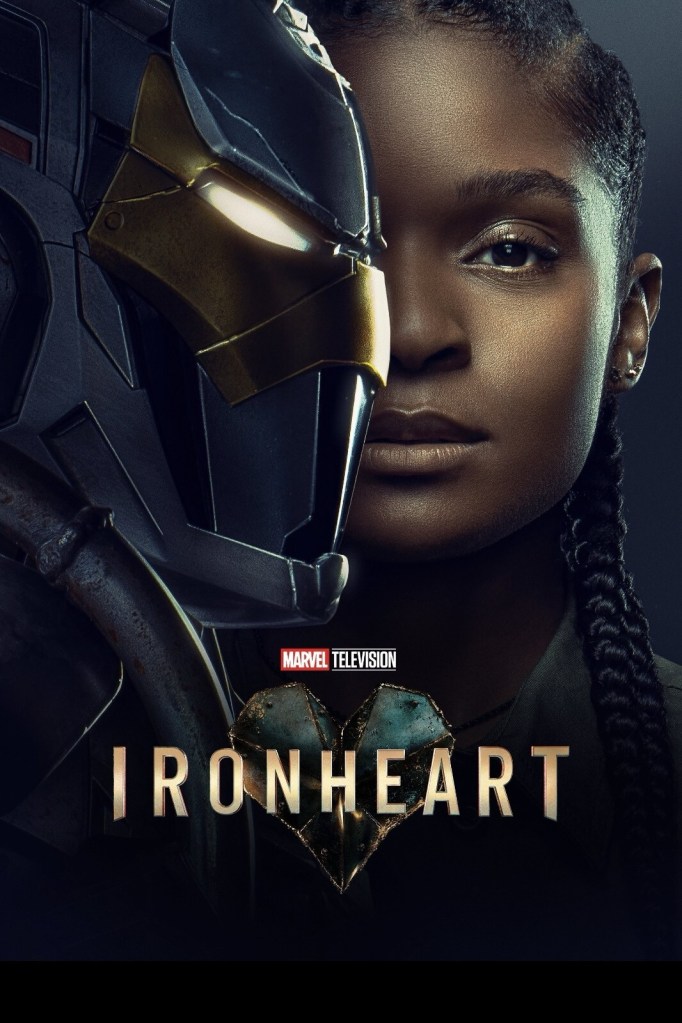
Riri Williams, Ironheart, stands beside her armor modeled after Iron Man, a symbol of the genius and potential that Marvel’s adaptation failed to honor.
When Marvel introduced Riri Williams in Black Panther: Wakanda Forever, she felt like a revelation. A young Black genius, bold and quick-witted, standing confidently beside Shuri and Wakanda’s leaders, she radiated promise. Audiences believed she was destined to inherit the mantle of brilliance that Tony Stark left behind.
The Disney Plus series Ironheart undid all of that. Rather than elevating Riri’s genius, the show stripped her down and leaned on clichés. Instead of building an earned character arc, Marvel forced one, and when audiences rejected it, Disney did not admit the problem was storytelling. It turned on its own fans, deflecting fair criticism as misogyny or racism. That response only deepened the sense of betrayal.
What made Ironheart sting was not representation but its absence of authentic narrative. Riri’s journey was reactive rather than inventive, her brilliance muted to the point where she seemed less capable than in Black Panther 2. Her supporting cast was too thin to provide depth, leaving Dominique Thorne to carry scenes without the balance that seasoned actors could have offered. This was the opposite of what Marvel did with Tom Holland’s Spider-Man, where young talent was elevated by veterans like Robert Downey Jr. and Michael Keaton. In Ironheart, there was no gravitas to steady her.
The most glaring missed opportunity was the arc itself. In the comics, Riri is mentored by Tony Stark’s AI, a natural continuation of Iron Man’s legacy and a relationship that challenges her intellect. That arc was abandoned in favor of an AI woman who felt more like a nagging caricature than a mentor. It was meant to look progressive, but it flattened Riri even further. Instead of sharpening her genius through real tests, the show reduced her to tropes and sidelined the one connection that could have tethered her to Marvel’s larger story.
What took its place was a parade of stereotypes. The single mother household. The absent father. The drive-by shooting that killed her stepfather. Drugs and street crime. Poverty. Black and Latino men both hyperviolent and emasculated. Struggle as the entire identity. These were not fresh interpretations of culture. They were shortcut stereotype boxes checked by writers who did not seem to understand the communities they were trying to represent.
Audiences are tired of this. They want aspiration and intelligence, not clichés. The success of Black Panther proved that. That film grossed more than $1.3 billion worldwide because it was rooted in authenticity and celebrated Black excellence. It trusted viewers to embrace complexity. Ironheart, by contrast, felt like it was written on autopilot, with representation treated as the main plot line coupled with bad writing.
The reception told the story. Ironheart failed to enter the top ten streaming shows at launch, averaging fewer than 90 million minutes per episode. Nielsen reported just 526 million minutes viewed in its debut week a fraction of Marvel’s earlier dominance. Viewers who began often did not finish. Critics offered cautious praise, but audiences were blunt. Rotten Tomatoes’ audience score fell into the mid-50s. IMDb scored it a dismal 3.7 out of 10. By every measure, this was the weakest Marvel Studios project to date.
Instead of listening, Disney dismissed its fans. Criticism was waved away as misogyny or racism. But this is dishonest. Marvel fans embraced Black Panther, Into the Spider-Verse, and Miles Morales because those stories were intelligent and authentic. They reject Ironheart because it was shallow. Viewers are not bigoted for noticing lazy storytelling. They are discerning enough to know when a studio has lost its way.
Riri Williams deserved better. She deserved a story that celebrated her genius and connected her to Iron Man’s legacy in a way that felt earned. She deserved writing that matched the promise we glimpsed in Wakanda. What we got instead was a hollow series that leaned on stereotypes, dulled its lead, and insulted its audience.
Marvel once thrived because it told stories with depth and intelligence, trusting its fans to embrace complexity. Ironheart showed what happens when that trust is broken. We are not rejecting representation. We are rejecting lazy representation. If Disney refuses to admit that the real problem is storytelling, it will not just be one show that fails. It will be the entire brand.
Disney did not fail Riri Williams. It failed to believe her brilliance was enough.



 Nkozi Knight
