
Starting your own blog has never been easier. In this post, we’ll cover the step-by-step process on how you can start a blog today, and why you …
How to Start a Successful Blog: A 12-Step Guide for Beginners
Personal and professional tips, inspiring stories of success and failures, travel information, and current news.
Starting your own blog has never been easier. In this post, we’ll cover the step-by-step process on how you can start a blog today, and why you …
How to Start a Successful Blog: A 12-Step Guide for Beginners

By N. Knight
February 2025
GAZA CITY — Seventy-seven years after the Nakba of 1948, in which Zionist paramilitary groups (later forming the Israeli Defense Forces) forcibly displaced more than 750,000 Palestinians during the creation of Israel, a new catastrophe is unfolding in Gaza. Then, as now, the mass removal of Palestinians was not just a consequence of war but a calculated effort to reshape the region’s demographics.
The original Nakba, or “catastrophe” in Arabic, saw entire villages erased, families expelled, and a people scattered across the Middle East with no path home. Today, with 1.5 million Palestinians displaced and Gaza reduced to rubble, history is repeating itself. What was once the forced exodus of Palestinian communities into Gaza and neighboring countries is now a campaign to permanently expel them from the land entirely.
And just as in 1948, this displacement has been backed by major world powers.
How the World Redefined a Nation Without Its People
Palestinians were never given a say in their removal. The decision to partition their homeland and create Israel was made by external powers, largely Britain and the United States, without the consent of the people already living there.
The Role of Winston Churchill and the British Mandate

Before Israel’s establishment, Palestine was under British rule as part of the League of Nations Mandate, a system intended to prepare nations for self-governance. But rather than supporting Palestinian self-determination, Britain instead paved the way for Zionist settlement under the Balfour Declaration of 1917, which promised a Jewish homeland in Palestine without consulting its Arab inhabitants.
Winston Churchill, as both Colonial Secretary and later as Prime Minister, was a staunch Zionist supporter who saw Jewish settlement as a British imperial interest. He dismissed Palestinian opposition outright, once stating:
“I do not admit that the dog in the manger has the final right to the manger, even though he may have lain there for a very long time.”
Under Churchill’s leadership, Britain facilitated Jewish immigration while crushing Palestinian resistance. By the time the British withdrew in 1948, Palestinians were politically powerless, abandoned to Zionist militias who would soon launch the campaign of forced displacement known as the Nakba.
Harry S. Truman’s Immediate Support for Ethnic Displacement

As the British withdrew, it was the United States under President Harry S. Truman that cemented Israel’s creation. Against the advice of his own State Department, which warned that recognizing Israel would spark mass displacement and long-term instability, Truman became the first world leader to formally recognize Israel just minutes after its declaration of independence on May 14, 1948.
Truman’s recognition was not just diplomatic. The United States provided Israel with critical financial and military aid, allowing the newly formed state to consolidate its territorial gains and prevent the return of displaced Palestinians.
The United Nations passed Resolution 194, affirming the right of Palestinian refugees to return to their homes. But Truman and his administration did nothing to enforce it. The result was that 750,000 Palestinians became permanent refugees, many of whom fled to the Gaza Strip only to find themselves trapped in a cycle of displacement that continues to this day.
From 1948 to 2025: A Continuing Nakba
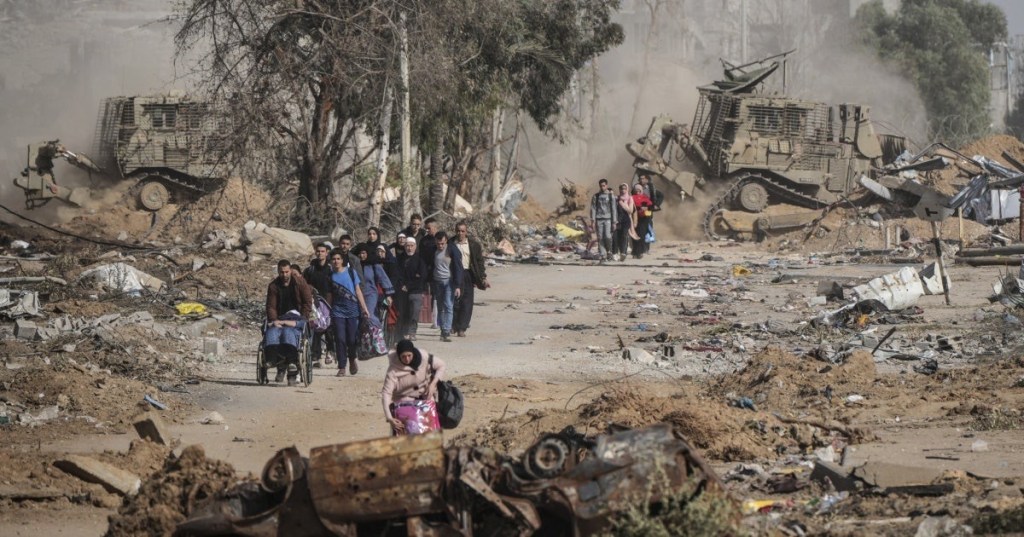
What is happening now in Gaza follows the same pattern. The Israeli bombardment of Gaza has destroyed entire neighborhoods, killed over 100,000 Palestinians, and displaced 1.5 million people which is twice the number of refugees from 1948. The infrastructure of survival including hospitals, schools, and road, has been systematically wiped out. And now, current United States President Donald Trump has proposed ensuring that Palestinians never return.
Donald Trump’s plan to permanently expel Gaza’s residents and rebuild the land for Jewish settlers mirrors the policies of 1948, except now, the forced displacement is being openly endorsed as official United States policy. When as a question about Palestinian residents, he suggested they go to Egypt and Jordan, and redevelop Gaza into what he described as the “Riviera of the Middle East.”
A Global Response, and a Question
Internationally, Trump’s proposal has been met with sharp opposition. Saudi Arabia, Jordan, and Egypt have explicitly rejected the idea, warning that any forced resettlement of Palestinians into their territories would be a violation of sovereignty and a red line for the region. Saudi Foreign Minister Prince Faisal bin Farhan called it “a blatant attempt at ethnic cleansing that will not be tolerated by the Arab world.” Egyptian President Abdel Fattah el-Sisi reaffirmed that Egypt “will not accept the forced displacement of Palestinians into the Sinai.” Both nations have signaled that such a move could undermine diplomatic relations with Israel and the United States.
Yet, despite these warnings, the pattern remains unchanged. A population is being forcibly removed, their land repopulated with another ethnic group, and the world is expected to accept it as the price of geopolitics.
Which raises the question.
If the forced removal of an entire people, the destruction of their homes, and the resettlement of their land with another group is not ethnic cleansing, then what is
And if the world will not act to stop it now, will it ever?
 Nkozi Knight